

Professional Grade Greenhouses: 9 Benefits for Home Growers
Table of Contents
- What Are Professional Grade Greenhouses and Why They Matter
- Extended Growing Season: Year-Round Cultivation Benefits
- Superior Greenhouse Climate Control Systems
- Types of Commercial Greenhouses for Different Needs
- Pest and Disease Management Through Environmental Control
- Maximizing Crop Yield and Agricultural Productivity
- Understanding Greenhouse ROI and Long-Term Operational Costs
- Commercial Greenhouse Advantages for Home Growers
Last Updated: July 31, 2026
Professional grade greenhouses extend growing seasons and protect valuable plants, enabling year-round cultivation. At Rooms Outdoors, we've helped countless homeowners transform backyards into productive growing spaces. Whether cultivating heirloom tomatoes, exotic orchids, or seedlings, professional greenhouses offer capabilities that casual gardeners often overlook. Below are nine distinct advantages that make these structures worth the investment.
What Are Professional Grade Greenhouses and Why They Matter
A professional grade greenhouse is a climate-controlled structure built with durable materials like polycarbonate or tempered glass, equipped with ventilation systems and environmental controls designed for intensive use. Unlike hobby greenhouses made from lightweight plastic, professional models prioritize durability, precision climate regulation, and operational efficiency.
These structures differ fundamentally from basic cold frames or low tunnels. Professional models include automated environmental regulation, proper drainage, and ventilation that maintains optimal growing conditions during extreme weather. Temperature fluctuations, humidity imbalances, and inadequate air circulation directly impact crop yield and plant health. A quality greenhouse maintains stable conditions enabling year-round growing rather than adapting to seasonal limitations.
The real value is what the structure enables: controlled environments eliminate guesswork. You're no longer at the mercy of unpredictable weather patterns or regional growing seasons.
Extended Growing Season: Year-Round Cultivation Benefits
Professional grade greenhouses enable growing far beyond your region's natural season. Where outdoor gardeners in northern climates might have 90-120 frost-free days, a greenhouse extends that to 200+ days or enables year-round cultivation with proper heating.
This extended season translates directly to productivity. You can start seedlings 6-8 weeks earlier than outdoor planting allows, giving transplants a significant head start. In fall, you continue harvesting while outdoor gardens shut down. Spring and fall shoulder seasons become productive growing windows.
Glass or polycarbonate glazing traps solar radiation, raising internal temperatures by 15-25°F on sunny days. Even unheated greenhouses provide frost protection and wind shelter that extends the viable growing window. Add supplemental heating, and you're growing fresh vegetables in January.
For homeowners in regions with short growing seasons, this benefit alone justifies the investment. Growers in the Pacific Northwest or upper Midwest can now cultivate heat-loving crops like peppers, eggplants, and melons that would otherwise fail outdoors.
Superior Greenhouse Climate Control Systems
Automated Environmental Regulation
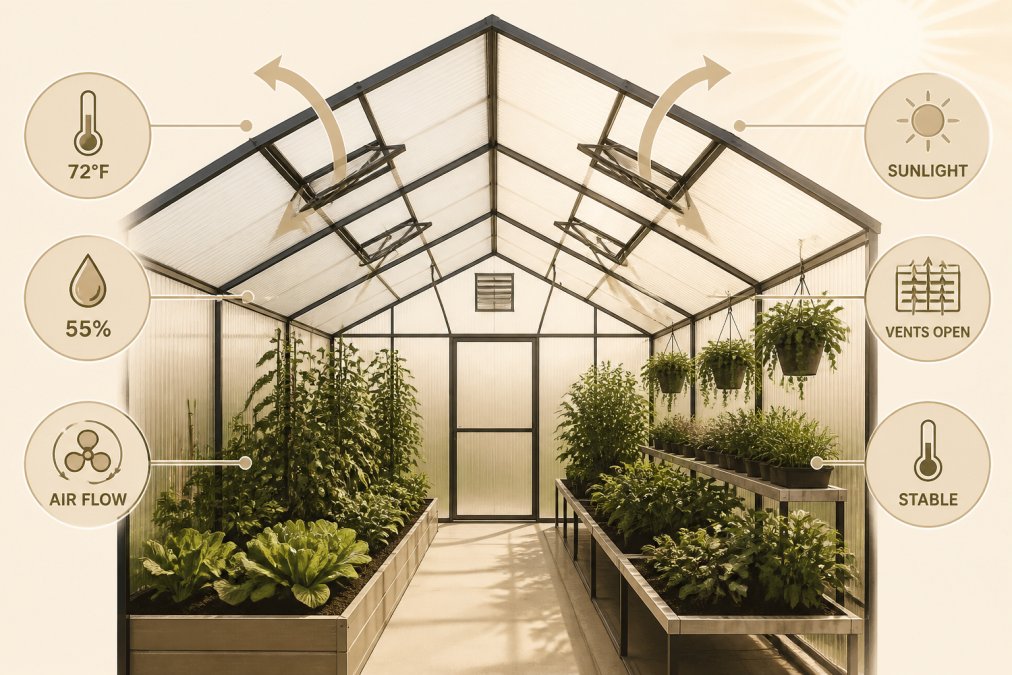
Professional grade greenhouses equipped with automated climate control remove guesswork from temperature and humidity management. Thermostats trigger ventilation fans when interior temperatures exceed your target range. Humidity sensors activate exhaust vents or misters to maintain optimal moisture levels. These systems operate without daily human intervention.
A greenhouse left unventilated on a warm spring day can reach 95°F+ even when outside temperatures are mild. Plants experience heat stress, flowering suffers, and pest pressure increases. Automated systems prevent these spikes by opening roof vents or sidewall louvers before temperatures climb.
Modern systems integrate IoT sensors that send alerts to your phone if conditions drift outside acceptable ranges. The system manages itself rather than requiring constant monitoring.
Thermal Regulation and UV Protection
Polycarbonate's twin-wall construction creates an insulating air layer, reducing heat loss by 20-30% compared to single-layer plastic. Tempered glass offers superior light transmission (90%+ versus 85% for polycarbonate) but provides less insulation. The choice depends on your climate and growing priorities.
Both materials block harmful UV wavelengths while transmitting the visible light spectrum plants need for photosynthesis. Plants grown under quality glazing develop stronger cell walls and more vibrant coloration than those under inferior plastic sheeting.
Thermal mass, materials that absorb and release heat, enhances climate stability. Water barrels, thermal storage walls, or concrete floors absorb excess daytime heat and release it at night, moderating temperature swings. This passive thermal regulation reduces the need for active heating or cooling, lowering operational costs.
Types of Commercial Greenhouses for Different Needs
Polycarbonate vs. Tempered Glass Options
Polycarbonate greenhouses dominate the professional market for home use. Twin-wall polycarbonate (typically 8-10mm thick) offers the best balance of durability, insulation, and affordability. The material withstands hail, high winds, and UV exposure without yellowing for 10+ years. Polycarbonate panels are lighter than glass, reducing structural load and installation complexity.
The Rooms Outdoors 10x18 Ft Polycarbonate Greenhouse with Rain Gutter & 4 Roof Vents exemplifies this approach. The aluminum frame supports polycarbonate panels while the rain gutter system manages water drainage, critical for preventing foundation issues. Four roof vents provide automated ventilation control.

Tempered glass greenhouses appeal to growers prioritizing maximum light transmission and aesthetic appeal. Tempered glass transmits 90%+ of available light, supporting higher photosynthesis rates and lasting 20+ years. However, glass is heavier, more expensive, and requires stronger framing. A single broken pane can disrupt thermal properties.
For most homeowners, polycarbonate represents the optimal choice, delivering 90% of performance benefits at 60% of the cost with superior durability and easier installation.
High Tunnel and Walk-In Configurations
Walk-in greenhouses (typically 6-12 feet wide, 8-20 feet long) are standard for residential use. You can stand upright and manage tasks comfortably. The Rooms Outdoors [12x8 Ft Walk-In Polycarbonate Greenhouse](https://roomsoutdoors.com/products/12x8-outdoor-greenhouse-walk-in-polycarbonate-green-house-with-aluminum-frame-for-backyard-black) provides 96 square feet of growing space, adequate for most home gardens, with easy access and ventilation management.

The 6x12 Ft Walk-In Polycarbonate Greenhouse with Sliding Door & Adjustable Roof Vent offers similar benefits with a sliding door that minimizes heat loss when entering and an adjustable roof vent for precise climate control.

High tunnels (hoop houses) use curved plastic stretched over metal hoops. They're cheaper and easier to construct, but lack structural rigidity, provide less precise climate control, and typically last 4-6 years before plastic degradation requires replacement.
For serious year-round cultivation, walk-in greenhouses with solid framing outperform high tunnels through superior longevity and operational consistency.
Pest and Disease Management Through Environmental Control
One of the most underrated benefits of professional greenhouses is pest and disease prevention through environmental management. Controlled environments eliminate many pest entry points. Screened vents prevent insect infiltration. Sealed doors and proper caulking keep out spider mites, whiteflies, and aphids that devastate outdoor plants.
Disease pressure drops dramatically in controlled climates. Powdery mildew, fungal leaf spots, and blight thrive in high humidity and poor air circulation. Professional greenhouses with adequate ventilation maintain humidity between 50-70%, suppressing fungal pathogens while supporting plant growth. Stagnant air creates microenvironments where humidity reaches 90%+, triggering disease outbreaks.
This environmental control reduces pesticide dependency. Instead of spraying chemicals weekly, greenhouse growers manage pests through cultural practices: removing affected leaves, improving air circulation, and maintaining optimal humidity. The result is cleaner plants, lower chemical input, and healthier produce.
Quarantine capability is another advantage. New plants can be isolated before introducing them to your main growing area, preventing pests or diseases from nurseries or garden centers.
Maximizing Crop Yield and Agricultural Productivity
Professional greenhouses directly increase productivity per square foot. Outdoor gardens produce one crop per season; greenhouses support multiple crops annually. A 6x12 greenhouse might yield 200-300 lbs of tomatoes per season outdoors, but 400-600 lbs with proper management and multiple plantings.
Extended growing season means more planting opportunities. Controlled climate reduces crop failures from frost, excessive heat, or disease. Optimized light and humidity support faster growth and earlier maturity.
Vertical growing systems further amplify yield. Trellised tomatoes, hanging baskets for strawberries, and tiered shelving maximize available space. A single greenhouse supports far more plants per square foot than ground-level outdoor beds.
Precision agriculture techniques become practical in greenhouses. Drip irrigation systems deliver water directly to root zones, reducing waste and improving plant health. Nutrient monitoring allows precise fertilization. These techniques require the controlled environment that greenhouses provide.
The yield increase translates to tangible value. A homeowner growing 500 lbs of tomatoes, peppers, and cucumbers annually produces food worth $800-$1,200 at retail prices. Over a 10-year greenhouse lifespan, that's $8,000-$12,000 in produce value, far exceeding the initial investment.
Understanding Greenhouse ROI and Long-Term Operational Costs
Initial Investment vs. Yield Returns
Professional grade greenhouses require significant upfront investment. Quality structures range from $600 for small walk-in models to $3,000+ for larger installations with automated systems.
A $2,000 greenhouse producing 400-500 lbs of vegetables annually generates roughly $1,000-$1,500 in food value (based on typical retail prices of $2-3 per pound). This creates a 2-3 year payback period based purely on food production. Beyond the payback period, every pound of vegetables produced is essentially free, assuming minimal operational costs.
However, financial ROI isn't the only calculation. Homeowners also value having fresh, pesticide-free produce year-round, the ability to grow specialty crops impossible in their climate, and the satisfaction of self-sufficiency.
Maintenance and Energy Efficiency Considerations
Long-term operational costs include heating, electricity for fans and controls, water, and maintenance. In mild climates, an unheated greenhouse requires minimal energy input, perhaps $100-$200 annually. In cold climates, supplemental heating adds $300-$800 annually depending on greenhouse size and insulation quality.
Maintenance costs are modest for quality structures. Polycarbonate greenhouses require occasional cleaning and inspection for damage. Aluminum frames resist rust and require no painting. The main maintenance expense is replacing worn weatherstripping or repairing damaged panels, which rarely occurs more than once per 5-year period.
Water costs depend on local rates and growing practices. A drip irrigation system uses 30-50% less water than hand watering, offsetting the cost of the system within one season.
| Greenhouse Feature | Annual Cost Impact | Payback Period |
|---|---|---|
| Basic walk-in structure | $0 | Initial investment only |
| Heating system (cold climate) | $400-800 | 3-5 years |
| Automated climate control | $200-400 (electricity) | 2-3 years |
| Drip irrigation system | -$100 savings vs. hand watering | 1 year |
| Maintenance & repairs | $50-150 | Ongoing, minimal |
Commercial Greenhouse Advantages for Home Growers
Space Efficiency and Scalability
Professional grade greenhouses enable intensive cultivation in small spaces. A 6x12 greenhouse (72 square feet) can support 50-100 plants depending on species. This density is impossible outdoors without severe disease and pest pressure.
Scalability is another advantage. Start with a single 6x12 greenhouse. If you find yourself regularly selling excess produce or gifting plants to neighbors, add a second greenhouse. The modular nature of quality structures allows expansion without major infrastructure changes.
Vertical growing systems within the greenhouse multiply effective growing space. Hanging baskets for strawberries, tiered shelving for seedlings, and trellised vining crops use vertical space that would otherwise sit empty. A single greenhouse becomes equivalent to 2-3 times its footprint in growing capacity through smart vertical organization.
This space efficiency matters for homeowners with limited yard space. A 400 sq ft backyard can accommodate a 6x12 greenhouse that produces as much as a 1,200 sq ft outdoor garden.
Regulatory Compliance and Zoning Considerations
Before investing in a professional greenhouse, verify local zoning regulations and building codes. Most jurisdictions classify greenhouses as accessory structures and allow them without special permits if they're under certain size thresholds (typically 100-200 square feet). Check with your local building department for specific requirements.
Setback requirements (distance from property lines) vary by location. Many areas require 5-10 foot setbacks. Foundation requirements differ as well; some jurisdictions require concrete foundations, while others allow the structure to sit directly on compacted soil.
Homeowners associations in some communities restrict greenhouse installation or require architectural approval. Review your HOA covenants before purchasing.
Height restrictions sometimes apply. A 7-foot-tall greenhouse might exceed local limits in some areas. Verify maximum structure height in your zoning code before purchasing.
Most residential greenhouses fall well within standard zoning allowances. Professional structures are designed with these regulations in mind.
Transforming your backyard into a year-round growing space requires choosing a greenhouse that matches your climate, growing goals, and space constraints. Professional grade greenhouses deliver measurable benefits, extended seasons, climate control, pest prevention, and productivity increases, that justify the investment for serious home growers. Rooms Outdoors curates premium greenhouse options like the [10x18 Ft Polycarbonate Greenhouse](https://roomsoutdoors.com/products/10x18-ft-polycarbonate-greenhouse-with-rain-gutter-4-roof-vents-heavy-duty-aluminum-greenhouse-for-outdoor-garden-backyard-black) and walk-in models built with durable aluminum frames, quality polycarbonate glazing, and ventilation systems that enable consistent environmental control. Start with a structure that fits your space and budget, then expand as your growing confidence and production goals increase. With proper planning and a quality greenhouse, you'll enjoy fresh, pesticide-free produce year-round while experiencing the satisfaction of creating a genuine agricultural space in your own backyard.
Frequently Asked Questions
What are the main advantages of a professional grade greenhouse compared to a basic hobby greenhouse?
Professional grade greenhouses offer superior climate control, extended growing seasons, better structural durability, and optimized crop yield through precision agriculture technologies. They feature reinforced aluminum frames, polycarbonate or tempered glass glazing, automated ventilation systems, and irrigation management, delivering consistent environmental conditions that hobby greenhouses cannot match. The investment in professional-grade systems typically yields higher productivity and lower long-term operational costs through energy efficiency and reduced pest losses.
How do greenhouse climate control systems improve crop yields and productivity?
Advanced climate control systems regulate temperature, humidity, and light to create optimal growing conditions year-round. Automated environmental controls maintain precise photoperiod and thermal regulation, enabling faster plant growth and extended harvests. Proper ventilation reduces disease pressure, while irrigation management delivers consistent nutrient availability. Studies show that professional-grade climate systems can increase agricultural productivity by 30-50% compared to uncontrolled environments, directly improving your greenhouse ROI and operational efficiency.
What is the difference between polycarbonate and tempered glass for professional grade greenhouses?
Polycarbonate glazing offers superior impact resistance, better insulation (R-value), and lower cost, making it ideal for most homeowners. Tempered glass provides maximum light transmission and aesthetic appeal but costs more and requires careful handling. Polycarbonate degrades slightly over 10 years; tempered glass lasts 20+ years. For commercial greenhouse advantages and long-term durability, polycarbonate suits climate-controlled environments, while tempered glass works best where maximum light and premium appearance justify higher maintenance costs.
What is the typical greenhouse ROI and how long does it take to recoup the investment?
ROI depends on your growing operation and local climate. A mid-sized professional greenhouse like the 10x18 ft polycarbonate model ($2,059) can generate returns within 2-4 years through extended season productivity and reduced pest/disease losses. Year-round cultivation enables multiple harvests, dramatically improving yield per square foot. Energy-efficient designs lower operational costs, while automation reduces labor. Homeowners typically see positive ROI through increased crop value, reduced grocery costs, and enhanced property value, especially when combining multiple growing seasons with precision agriculture technologies.
This article was written using GrandRanker