

Choosing the Right Greenhouse for Your Backyard: 2026 Guide
Table of Contents
- Assessing Your Growing Goals and Growing Season
- Greenhouse Size Guide: Finding the Right Fit
- Greenhouse Materials Comparison: Frame and Glazing
- Greenhouse Ventilation Tips and Airflow Management
- Heating a Backyard Greenhouse for Winter Growing
- Site Preparation, Drainage, and Foundation Requirements
- Permitting, Zoning Laws, and DIY vs. Kit Assembly
- Budgeting and Long-Term Maintenance Costs
Choosing the Right Greenhouse for Your Backyard: 2026 Guide
Last Updated: August 2, 2026
When choosing a greenhouse for backyard spaces, most homeowners focus only on size and price, then discover later that ventilation problems, poor sun exposure, or inadequate foundation work have created a frustrating growing environment. The difference between a greenhouse that thrives and one that disappoints comes down to deliberate planning across seven critical dimensions. This guide shows you exactly how to evaluate your specific needs, climate, and space constraints to select a greenhouse that delivers seasons of reliable growing.

Assessing Your Growing Goals and Growing Season
Before measuring your backyard or comparing materials, clarify what you want to grow and when. This decision filters every other choice that follows, from size to heating systems to glazing type.
Year-Round vs. Seasonal Growing
Year-round greenhouse growing demands thermal mass, active heating systems, and superior insulation. Seasonal growing can rely on passive solar gain and natural ventilation for much of the year.
If planning year-round production, expect to invest in a heating system. Passive heating strategies like thermal mass (water barrels, stone, or masonry) can offset some heating costs, but won't sustain production through harsh winters without supplemental heat. Seasonal growers have more flexibility, a greenhouse that captures spring warmth and fall sun can extend your growing season by eight to twelve weeks without heating infrastructure.
Climate Zone Considerations
Your USDA hardiness zone determines what's possible without heating. Check your specific zone using the USDA Plant Hardiness Zone Map. Cold-hardy greens and root crops can survive in an unheated greenhouse down to zone 4 with good insulation and thermal mass.
Snow load is another zone-specific factor. Growers in regions with significant winter snow need stronger roof structures rated for 40+ pounds per square foot. Wind resistance matters equally, check your local wind zone using ASHRAE Wind Speed Maps and choose a greenhouse with anchoring systems designed for your specific exposure.

Greenhouse Size Guide: Finding the Right Fit
Size is the most visible decision, yet often made poorly. Homeowners either build too small and quickly outgrow the space, or too large and struggle to maintain an oversized structure. The right size balances your actual growing ambitions with the space you can realistically maintain. A 6x12 foot greenhouse works well for serious hobbyists and seed starters. A 10x18 foot model suits growers with multiple crop cycles and diverse plantings.
Square Footage and Layout Planning
Calculate usable growing space by multiplying length by width, then add 20 percent for pathways and workspace. A 6x12 foot greenhouse provides 72 square feet of usable growing space; a 10x18 foot model gives you 180 square feet.
Layout matters as much as total area. A narrow greenhouse (6 feet wide) forces you to choose between a center pathway with benches on both sides, or benches running the full depth with access only from the ends. A wider greenhouse (8-10 feet) offers flexibility: center pathway with side benches, or two parallel pathways with benches between them.
Rooms Outdoors offers several popular sizes. The 12x8 Ft Walk-In Polycarbonate Greenhouse ($629) suits gardeners with moderate space and budget, while the 10x18 Ft Polycarbonate Greenhouse with Rain Gutter & 4 Roof Vents ($2,059) accommodates serious growers with diverse plantings.
Eave Height and Ridge Height for Usability
Eave height (distance from ground to where the roof begins) determines whether you can work comfortably without stooping. A 6-foot eave height accommodates most gardeners standing upright. Ridge height (the roof peak) affects interior volume and light distribution. An 8-foot ridge height feels spacious and allows for tall plants or hanging baskets. Adequate height improves air circulation, allowing warm air to rise and cool air to sink, reducing humidity and fungal disease.
Greenhouse Materials Comparison: Frame and Glazing
Frame material and glazing choice determine durability, light transmission, insulation value, and long-term maintenance burden.
Frame Materials: Aluminum, Steel, and Cedar
Aluminum frames dominate the market. They're lightweight, corrosion-resistant, and require minimal maintenance. Steel frames are stronger and cheaper but rust without regular painting. Cedar frames offer aesthetic appeal and natural insulation superior to aluminum or steel, but require sealing every few years and cost significantly more. For most homeowners, aluminum frames offer the best balance of durability, cost, and maintenance-free operation.
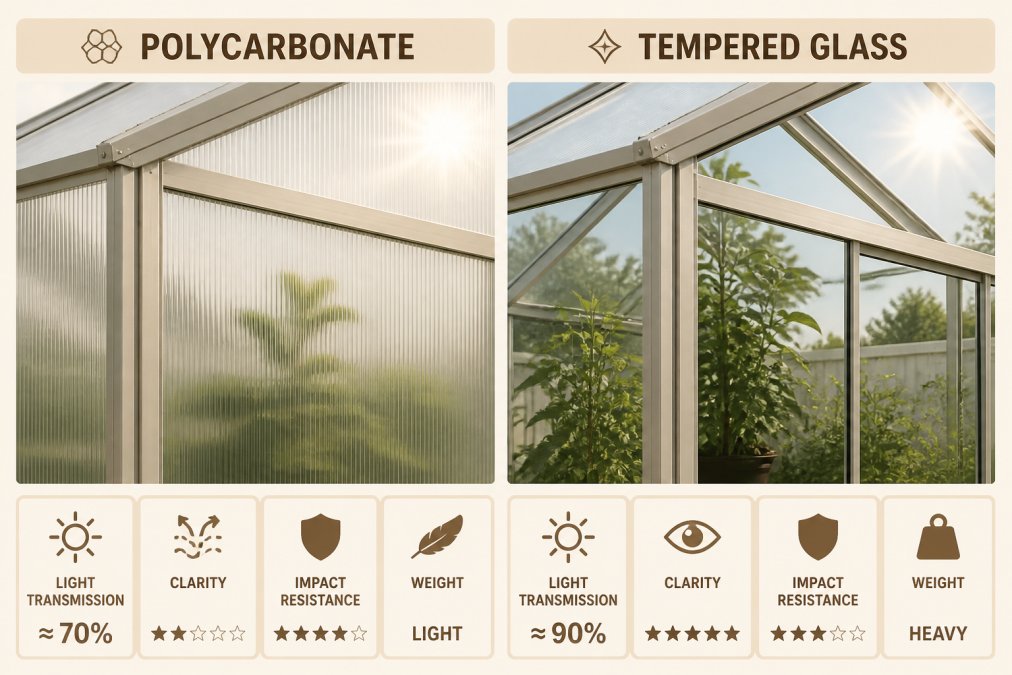
Glazing Options: Polycarbonate, Tempered Glass, and Film
Polycarbonate is the most popular glazing material. It's impact-resistant, diffuses light evenly, and provides better insulation than single-pane glass. Polycarbonate degrades under UV exposure over 10-15 years, eventually becoming cloudy or brittle.
Tempered glass transmits more light (critical for seed starting) and lasts indefinitely without degradation, but costs significantly more and shatters if impacted hard. Polyethylene film is the budget option but degrades quickly (1-2 years) and offers minimal insulation.
Most serious growers choose polycarbonate for the balance of cost, durability, and performance.
UV Protection and Insulation R-Values
Twin-wall polycarbonate provides an R-value around 1.6; triple-wall polycarbonate reaches R-value toward 2.0. Year-round growers need active heating or significant thermal mass. UV protection is critical for polycarbonate longevity. Look for polycarbonate with UV-blocking coatings on the exterior layer, extending the material's life from 10-12 years to 15-20 years.
Greenhouse Ventilation Tips and Airflow Management
Ventilation is where most greenhouse beginners stumble. Overheating and humidity are far more common problems than cold. A greenhouse without adequate ventilation becomes humid and disease-prone by mid-spring, as fungal diseases thrive in stagnant, humid air.
Roof Vents and Louvers for Natural Airflow
Roof vents allow hot air to rise and exit; cooler air enters through door openings or lower vents. Automatic roof vents use temperature-sensitive hydraulic pistons that open when interior temperature exceeds a threshold (typically 75°F), eliminating manual adjustment.
Aim for at least one-third of your greenhouse roof area to be vented. A 10x18 foot greenhouse should have roughly 60 square feet of vent area. The Rooms Outdoors 10x18 Ft model includes 4 roof vents, providing excellent natural airflow.
Humidity Control and Condensation Prevention
Humidity inside a greenhouse naturally rises as plants transpire and soil moisture evaporates. On cold mornings, humid air cools and condenses on glazing and plant leaves, creating ideal conditions for fungal disease.
The solution is airflow. Even gentle air circulation (a small oscillating fan running a few hours daily) dramatically reduces condensation and fungal pressure. Crack a roof vent or door first thing in the morning to allow humid air to escape. For year-round growers, a dehumidifier (50-pint capacity, $300-500) maintains humidity below 70 percent.

Heating a Backyard Greenhouse for Winter Growing
Year-round growing requires heat. The question is whether you'll rely on passive strategies or active systems.
Thermal Mass and Passive Heating Strategies
Thermal mass absorbs heat during the day and releases it at night, moderating temperature swings. A 55-gallon water barrel absorbs roughly 450 BTU of heat per degree Fahrenheit, enough to moderate a small greenhouse's overnight temperature drop by several degrees. Passive heating works best in shoulder seasons when daytime temperatures are mild and nighttime drops are modest.
Active Heating Systems and Energy Efficiency
Most year-round growers use thermal mass plus active heating. A small electric heater (3-5 kW) with a thermostat maintains minimum temperatures during cold snaps. Running costs depend on your electricity rate and winter severity, but expect $200-400 per winter season for a 10x18 foot greenhouse in zone 5. The most efficient heating approach: insulate well (twin-wall or triple-wall polycarbonate), add thermal mass (water barrels or stone), and use a small thermostat-controlled heater as backup.
Site Preparation, Drainage, and Foundation Requirements
Where you place your greenhouse matters as much as what you buy. A poorly sited greenhouse battles drainage problems, inadequate sun exposure, and wind exposure throughout its life.
Sun Exposure and Shade Cloth Considerations
Most crops need 6-8 hours of direct sun daily. Identify the sunniest spot in your yard, ideally south-facing (in the Northern Hemisphere) to maximize winter sun. Avoid placing your greenhouse in the shadow of large trees or buildings. Many growers use removable shade cloth (30-50% shade density) during peak summer to prevent overheating, attaching it to the exterior and removing it in fall to maximize fall sun.
Anchoring Systems and Wind Resistance
Wind is the silent killer of poorly installed greenhouses. Anchoring systems vary by frame type and foundation depth. Most kit greenhouses include anchoring brackets that bolt to a concrete foundation. The foundation should extend at least 12-18 inches below grade in cold climates and be reinforced with rebar. In high-wind areas, consider additional bracing like diagonal cables or guy wires from the roof to ground anchors.
Permitting, Zoning Laws, and DIY vs. Kit Assembly
Before ordering your greenhouse, check local zoning and building codes. Some jurisdictions allow greenhouses as accessory structures without permits; others require permits, setback distances, or architectural review.
Local Permitting Requirements and Setback Rules
Most municipalities classify greenhouses as accessory structures and allow them in residential zones without special permits if they meet size and setback requirements. Common rules include setback from property line (5-10 feet) and maximum lot coverage (15% of lot area). Call your local building department and describe your planned greenhouse. Ask specifically about setback requirements and whether a permit is needed. If required, the process is usually straightforward and inexpensive ($50-200).
DIY vs. Kit Assembly: Difficulty and Time Investment
Most backyard greenhouses come as kits with pre-cut parts and assembly instructions. DIY assembly typically takes 8-16 hours for a 6x12 foot greenhouse and 20-30 hours for a 10x18 foot model. Hiring a contractor to assemble costs $800-1,500 for a medium-sized greenhouse. For many homeowners, this is worth the cost to avoid frustration and ensure proper assembly.
The critical step most DIYers skip: foundation preparation. Pouring a level concrete slab or gravel pad takes more time than assembly and is where mistakes cause long-term problems.
| Assembly Approach | Time Investment | Cost | Best For |
|---|---|---|---|
| Full DIY (foundation + assembly) | 30-40 hours | $0-300 | Experienced builders, flexible schedules |
| DIY assembly, hire foundation | 8-16 hours | $500-800 | Most homeowners, good balance |
| Full hire-out | 0 hours | $1,500-2,500 | Busy schedules, high-end installations |
Budgeting and Long-Term Maintenance Costs
The purchase price is just the first cost. A complete greenhouse installation breaks down roughly like this:
- Greenhouse kit: $600-3,000 depending on size and materials
- Foundation (concrete slab): $400-800
- Assembly labor (if hired): $800-1,500
- Ventilation upgrades (fans, automatic vents): $200-500
- Heating system (if year-round): $500-2,000
- Benches and shelving: $200-800
Total installed cost for a quality 10x18 foot polycarbonate greenhouse: roughly $3,500-6,000. Annual maintenance costs are modest: replacing worn weatherstripping, cleaning glazing, and replacing polycarbonate panels as they degrade (typically 15-20 years). Budget $100-300 annually for maintenance and minor repairs.
A well-maintained greenhouse extends your growing season by 4-6 months, protects plants from weather damage and pests, and allows you to grow crops that wouldn't survive in your climate zone.
Choosing the right greenhouse for backyard growing isn't complicated once you understand the key variables: your growing goals, climate zone, site conditions, and budget. Rather than chasing the biggest model or the cheapest price, invest time in assessing your actual needs, then select a greenhouse that matches those needs precisely.
Rooms Outdoors offers thoughtfully designed greenhouses in multiple sizes with polycarbonate glazing, aluminum frames, and integrated ventilation. The 6x12 Ft Walk-In Polycarbonate Greenhouse ($569) suits hobbyists and seed starters; larger models accommodate ambitious year-round growers. With free shipping on orders over $1,500 and secure payment processing, you can invest with confidence in transforming your backyard into a serene growing retreat built to last.
Frequently Asked Questions
What size greenhouse should I choose for a beginner?
Most beginners start with 6x12 or 8x12 feet, offering enough square footage for seed starting and seasonal crops without overwhelming maintenance. The 6x12 ft walk-in polycarbonate greenhouse from Rooms Outdoors at $569 is an affordable entry point. Consider your available space and whether you'll need room for benches, pathways, and future expansion. Eave height should be at least 6.5 feet for comfortable work and adequate airflow.
Do I need a permit to build a greenhouse in my backyard?
Permit requirements vary significantly by location. Many jurisdictions require permits for structures over 120 square feet or those with permanent foundations. Check your local building department and HOA rules before purchasing. Some areas have zoning setback requirements (typically 5-10 feet from property lines). A few jurisdictions classify small greenhouses as temporary structures requiring no permit, but this is not universal. Contact your city or county building office for specific rules in your area.
What's the best glazing material for a backyard greenhouse?
Polycarbonate offers the best balance for most homeowners: it provides 99% UV protection, excellent insulation (R-value around 1.6), and is nearly unbreakable. Tempered glass offers superior clarity and light transmission but costs more and breaks more easily. Film is the cheapest option but requires annual replacement. The 10x18 ft polycarbonate greenhouse with rain gutter and roof vents from Rooms Outdoors ($2,059) demonstrates how polycarbonate combines durability with practical ventilation features for year-round use.
How do I keep a backyard greenhouse warm during winter?
Use thermal mass (water barrels or stone) to absorb daytime heat and release it at night, raising temperatures 5-10 degrees. Ensure polycarbonate glazing with good insulation R-values (aim for R-2 or higher). Add passive venting during warm days to prevent overheating. For active heating in colder climates, consider electric heaters or propane systems with thermostat controls. Proper ventilation prevents humidity buildup while maintaining warmth. In zones below 6, you may need supplemental heat to maintain growing conditions year-round.
What ventilation features should a backyard greenhouse have?
Look for roof vents (louvers) that open automatically or manually to release hot air and control humidity. Side vents or sliding doors improve airflow. The 10x18 ft polycarbonate greenhouse includes 4 roof vents for effective temperature and humidity management. Aim for vents covering 15-20% of floor area. Proper ventilation prevents fungal diseases, reduces condensation, and maintains optimal growing conditions. Consider automated vent openers if you're away during the day, as temperature can spike rapidly inside.
Should I choose a kit greenhouse or build from scratch?
Kit greenhouses from reputable manufacturers (like Rooms Outdoors) save time and ensure structural integrity. Assembly typically takes 8-16 hours for an 8x12 structure. Building from scratch offers customization but requires carpentry skills, permits research, and sourcing quality materials separately. Kits include pre-cut frames, glazing, and hardware sized to work together. For most homeowners, kits provide better value: they're engineered for wind and snow load resistance, include anchoring systems, and come with assembly instructions. DIY builds work if you have construction experience and time.
How much does a quality backyard greenhouse cost?
Entry-level polycarbonate greenhouses start around $569 (6x12 ft models). Mid-range options like the 12x8 ft at $629 offer good value for serious gardeners. Larger structures like the 10x18 ft greenhouse at $2,059 provide significant growing space. Budget 30-50% more for site preparation, foundation work, and optional upgrades like automated ventilation or heating systems. Premium tempered glass models cost 2-3 times more than polycarbonate. Consider long-term value: quality materials reduce maintenance costs and last 10-15+ years.
This article was written using GrandRanker