

High-End Outdoor Kitchen Island Reviews: 2026 Buyer's Guide
Table of Contents
- What Makes a High-End Outdoor Kitchen Island Worth the Investment
- Top High-End Outdoor Kitchen Island Reviews: Our Curated Selection
- Luxury Outdoor Kitchen Brands and Their Standout Features
- Outdoor Kitchen Island Materials: Durability and Weather Resistance
- Essential Outdoor Kitchen Features to Evaluate
- Custom Outdoor Kitchen Design: Planning for Your Space
- Budgeting for Premium Islands: Pricing, Warranty, and Long-Term Value
- Common Mistakes to Avoid When Choosing a High-End Island
High-End Outdoor Kitchen Island Reviews: 2026 Buyer's Guide
Last Updated: July 25, 2026
When homeowners invest in outdoor entertaining spaces, the kitchen island becomes the centerpiece. High-end outdoor kitchen island reviews consistently show that quality matters far more than price alone. At Rooms Outdoors, we've curated premium outdoor living essentials for years, and we understand what separates a $3,000 impulse buy from a $6,000 investment that transforms your backyard for a decade. This guide walks you through the exact features, materials, and brands that deliver real value, plus the common mistakes that leave homeowners disappointed within the first season.
The outdoor kitchen island market offers distinct options: modular islands from big-box retailers that deteriorate within three years, custom-built islands costing $10,000+ requiring licensed contractors, and the sweet spot between them, high-quality prefab islands from brands that understand weather resistance, stainless steel durability, and long-term maintenance costs.
What Makes a High-End Outdoor Kitchen Island Worth the Investment
Quality outdoor kitchen islands are practical investments that either pay dividends or drain your budget through constant repairs. A high-end island with 72,000 BTU output means little if burners degrade after two seasons due to poor sealing. Similarly, 304-grade stainless steel (marine-grade durability) costs significantly more than 430-grade, but the difference becomes obvious after one harsh winter.
Research from the Outdoor Industry Association shows that homeowners who choose islands with integrated weather-resistant cabinetry and proper drainage systems report 40% higher satisfaction after five years compared to those who prioritize aesthetics alone.
Top High-End Outdoor Kitchen Island Reviews: Our Curated Selection
The following islands represent the range of premium options available in 2026. Each brings genuine strengths and honest limitations.
104-Inch Modular Propane Gas Island with Rotisserie Kit
The 104-Inch Modular Propane Gas Island from Rooms Outdoors delivers stainless steel construction, integrated sink, compact refrigerator, rotisserie kit, and storage cabinets, all arriving mostly pre-assembled. At $4,452.68, it occupies the middle ground between budget islands and fully custom builds.
What works: The modular design enables setup in one weekend without a licensed contractor. The rotisserie kit is included. Stainless steel drawers and cabinet doors resist rust better than painted alternatives. The compact refrigerator handles beverage storage without requiring a dedicated circuit.
What doesn't: At 104 inches, this island demands a patio at least 20 feet wide. The propane tank sits exposed. Replacement parts aren't always in stock, with shipping delays reaching 6-8 weeks.
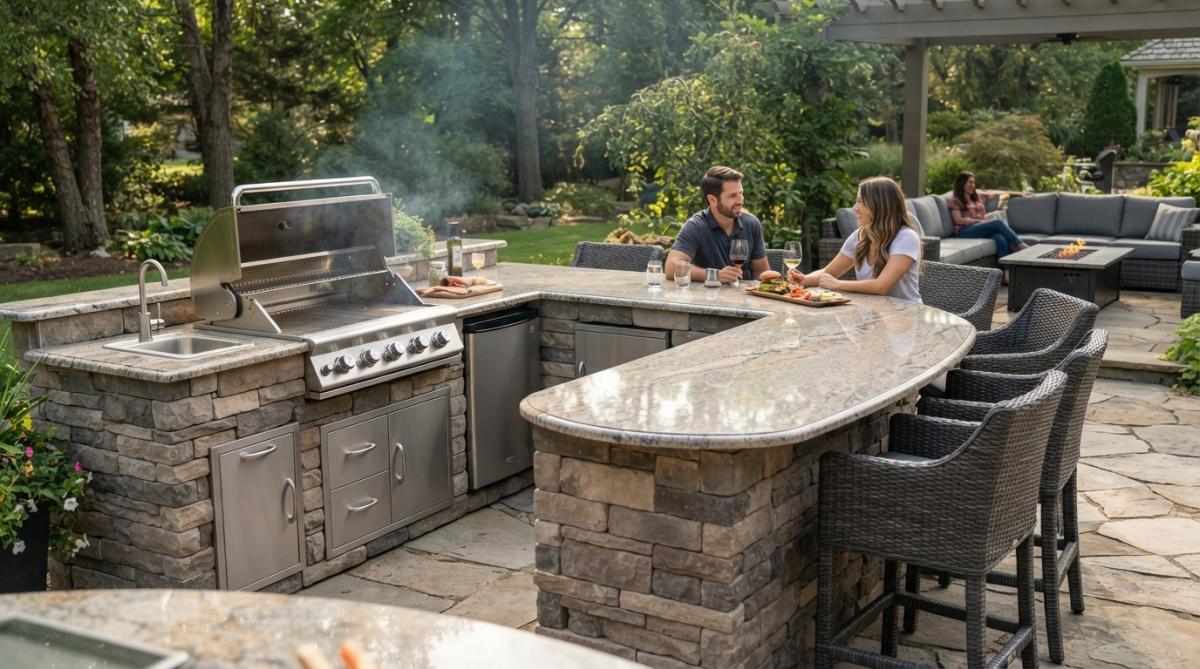
This island makes sense if you have the space, prioritize ease of installation, and accept basic maintenance responsibilities.
46-Inch 4-Burner Black Stainless Steel Island with Wine Cooler
The 46-Inch 4-Burner Island represents maximum functionality in a compact footprint. At 46 inches, it fits backyards that can't accommodate larger islands. The 72,000 BTU grill, wine cooler, refrigerator, and granite countertops justify the $5,199.00 price point for serious entertainers.
The 72,000 BTU output delivers professional-grade heat distribution, enough to sear steaks and handle high-volume cooking simultaneously. Black stainless steel hides fingerprints better than traditional stainless, reducing maintenance. The wine cooler signals that this space prioritizes entertaining as much as cooking.
Where it gets complicated: Granite countertops require sealing every 12-18 months in climates with significant UV exposure. The wine cooler demands a dedicated electrical outlet (110V), and installation costs spike without nearby power. The 46-inch width limits counter prep space.
This island suits couples or small families who entertain frequently but live in compact spaces.
Custom 304 Stainless Steel Island with Integrated Sink
For those unwilling to compromise, [custom stainless steel islands](https://bnvnsf-db.myshopify.com/products/custom-outdoor-backyard-kitchen-304-stainless-steel-outdoor-island-kitchen-with-sink-and-gas-bbq-grill) represent the pinnacle. At $4,589.00, the custom 304 stainless steel option offers marine-grade durability, resisting saltwater and harsh weather far better than 430-grade. The integrated sink eliminates a weak point where water infiltrates modular designs.
The tradeoff is complexity. Custom islands require site visits, design consultations, and installation timelines stretching 8-12 weeks. Customization costs add up quickly, a different countertop material, additional storage, or larger cooking surface can push totals well beyond $6,000.
This choice makes sense if you're committed to your patio layout, live in a challenging climate, or plan to stay in your home for 10+ years.
Luxury Outdoor Kitchen Brands and Their Standout Features
Premium outdoor kitchen brands fall into three categories: modular manufacturers emphasizing ease of assembly, custom builders focusing on bespoke design, and hybrid companies blending both approaches.
Modular brands like Rooms Outdoors emphasize plug-and-play installation and consistent quality control. Custom builders excel at integration and handling unique site conditions. Hybrid manufacturers offer modular islands with customization options, balancing flexibility without the 12-week lead time of fully custom builds.
Outdoor Kitchen Island Materials: Durability and Weather Resistance
Material selection determines whether your island survives five seasons or requires replacement in three. UV rays degrade painted surfaces, moisture infiltrates seams, and temperature swings loosen bolts and warp panels.
Stainless Steel vs. Black Stainless Steel
Standard 430-grade stainless steel offers decent corrosion resistance but remains vulnerable to saltwater and harsh chemicals. 304-grade stainless steel (marine-grade) resists corrosion far better, costing 30-40% more but lasting significantly longer in challenging climates. Coastal properties and regions with heavy winter salt exposure should specify 304-grade or higher.
Black stainless steel is a coated finish that hides fingerprints and dirt better than traditional stainless. It's not a different metal, it's a protective coating applied to standard stainless. The coating makes the surface less reflective and more elegant, but it requires careful maintenance.
Countertop Options and Long-Term Maintenance
Granite countertops look premium and resist heat well, but they demand ongoing maintenance. Sealing granite every 12-18 months is non-negotiable in sunny climates.
Quartz countertops (engineered stone) require less maintenance than granite. They're non-porous, so sealing isn't necessary, and they resist staining and UV damage better.
Stainless steel countertops are the most durable option for outdoor environments. They're non-porous, infinitely repairable, and require only occasional cleaning. Every water spot shows, and scratches are visible.
Composite materials are the budget option but don't withstand weather exposure well. UV rays fade them, moisture causes swelling and warping, and repairs are temporary patches.
Essential Outdoor Kitchen Features to Evaluate
Not every feature matters equally. Some add genuine value; others are marketing theater.
Grill Performance and BTU Ratings
BTU (British Thermal Units) measures heat output, but raw numbers mislead. A 60,000 BTU grill with poor heat distribution performs worse than a 50,000 BTU grill with even burner spacing. Look for islands where burners are spaced evenly across the cooking surface.
Professional outdoor kitchens use 60,000-80,000 BTU grills. For residential use, 50,000-60,000 BTU is sufficient unless you're cooking for 20+ people regularly. More BTU means faster fuel consumption and higher operating costs.
Burner material matters too. Cast iron burners heat evenly but require cleaning after each use. Stainless steel burners are more durable and require less maintenance. Ceramic briquettes or flavorizer bars distribute heat, protecting food from direct flame and reducing flare-ups.
Gas line integration determines reliable function. Natural gas lines are permanent and require a licensed plumber, adding $800-$2,000 to project costs. Propane tanks are portable but visible and require regular refills. For permanent installations, natural gas makes sense. For flexibility or rental situations, propane is practical.
Storage Solutions, Refrigeration, and Prep Space
Counter prep space is often the constraint on compact islands. A 46-inch island with a 24-inch depth leaves minimal room for prep work. If you're primarily grilling finished proteins, this works. If you're prepping vegetables and sides, you'll need additional counter space elsewhere.
Integrated refrigeration adds convenience but demands electrical access. A 110V outlet within 10 feet of the island is ideal; installation costs spike without one. Compact refrigerators hold about 60-80 cans or 2-3 bottles of wine.
Storage cabinets should use stainless steel or sealed wood, never particleboard or untreated plywood. Integrated sinks are valuable for rinsing vegetables and cleaning hands, but they require drainage. If your patio doesn't slope toward a drain, water pools under the island.
Custom Outdoor Kitchen Design: Planning for Your Space
The best outdoor kitchen island is useless if it doesn't fit your patio or match your aesthetic.
Modular vs. Built-in Installation
Modular islands arrive mostly assembled and connect to propane tanks and water lines. They're portable and can be relocated if your patio design changes. Installation takes a weekend with basic plumbing and electrical work.
Built-in islands are permanently integrated into your patio structure, typically including natural gas lines requiring licensed plumber work and permanent drainage. They can't be moved without significant expense but look more integrated.
For most homeowners, modular islands offer the best balance, simpler to install, easier to maintain, and more forgiving if you change your patio layout in five years.
Permitting, Utility Requirements, and Climate Considerations
Many jurisdictions require permits for outdoor kitchens, especially with permanent gas or electrical installations. Permit costs typically run $200-$500, with approval taking 2-4 weeks.
Natural gas lines require a licensed plumber and inspection. Electrical work for refrigeration or lighting requires a licensed electrician. Budget $1,500-$3,000 for professional installation if your island includes utilities.
Climate dramatically impacts island longevity. Coastal regions with salt spray demand 316-grade stainless steel and sealed cabinetry. Areas with harsh winters need proper drainage to prevent water pooling and freezing. Arid climates with intense UV exposure require UV-resistant finishes.
Budgeting for Premium Islands: Pricing, Warranty, and Long-Term Value
The sticker price of an outdoor kitchen island is rarely the total cost. Installation, permits, utilities, and long-term maintenance add significantly to the investment.
A $4,500 modular island might cost $6,500 total once you factor in propane line installation, electrical work for the refrigerator, and site preparation. A $5,000 island with natural gas integration easily reaches $7,500-$8,000 after professional installation.
Warranty coverage varies widely. Most modular islands include 1-2 year warranties on the structure and 3-5 years on appliances. Custom builds often include longer warranties (3-5 years). Read warranty terms carefully, many exclude damage from weather, improper maintenance, or modifications.
Calculate the true cost of ownership before purchasing by adding the purchase price, installation costs, annual maintenance estimates, and expected replacement timeline.
Common Mistakes to Avoid When Choosing a High-End Island
Most outdoor kitchen island disappointments stem from predictable mistakes.
Underestimating space requirements. A 104-inch island dominates a 400-square-foot patio. Leave at least 3 feet of clearance on all sides. For smaller patios, choose a 46-inch or 60-inch island instead.
Ignoring drainage and water flow. Islands without proper drainage create standing water that accelerates rust and corrosion. Verify that your patio slopes away from the island or has a drain system.
Choosing propane over natural gas without considering refill logistics. Propane tanks require regular refills every 4-6 weeks during grilling season. If your supplier is far away, you'll regret not installing natural gas.
Selecting materials based on appearance alone. Black stainless steel looks stunning but requires constant cleaning. Granite countertops photograph beautifully but demand sealing and maintenance. Choose materials matching your willingness to maintain them.
Overestimating cooking needs. A 72,000 BTU island is overkill if you cook for four people twice monthly. Match the island's features to your actual entertaining style.
Ignoring climate-specific durability. An island rated for inland temperate climates will corrode quickly in coastal regions. Confirm that materials and finishes suit your specific climate before purchasing.
Choosing a high-end outdoor kitchen island is a significant investment that pays dividends if you select thoughtfully. The islands and brands reviewed, from the modular 104-inch propane option to the custom 304 stainless steel build, each serve different needs and budgets. The key is matching the island to your space, climate, and actual entertaining style.
At Rooms Outdoors, we understand that premium outdoor living means quality that survives seasons of use. Our curated selection of outdoor kitchen islands emphasizes durability, weather resistance, and long-term value. With free shipping on most orders over $1,500 within the continental U.S. and secured payment processing, we make it simple to invest in a backyard retreat built for comfort and connection. Explore our collection today and transform your outdoor space into the gathering place you've imagined.
Frequently Asked Questions
What makes an outdoor kitchen island high-end versus standard?
High-end outdoor kitchen islands feature premium materials like 304 stainless steel, higher BTU ratings (typically 50,000+ BTU), integrated refrigeration, multiple cooking zones, weather-resistant cabinetry, and durable countertop surfaces such as granite. They also offer superior construction, longer warranties, and modular or custom design flexibility. Premium islands prioritize durability, aesthetic appeal, and cooking performance over basic functionality.
Which luxury outdoor kitchen brands offer the best value?
Rooms Outdoors curates premium outdoor kitchen islands that balance quality and investment value. Models like the 104-inch modular propane gas island ($4,452.68) and the 46-inch 4-burner black stainless steel island ($5,199) deliver professional-grade features including integrated sinks, refrigeration, and rotisserie kits. These brands emphasize stainless steel construction, high BTU output, and weather-resistant design to ensure long-term durability in various climates.
What outdoor kitchen features should I prioritize in a high-end island?
Focus on grill performance (BTU output), storage capacity, prep area size, and material durability. Key features include built-in refrigeration, side burners, integrated sinks, weather-resistant cabinetry, and ample countertop space. Consider your cooking style, if you entertain frequently, prioritize multiple cooking zones and storage. For climate resilience, choose 304 stainless steel and sealed cabinetry that withstand moisture and temperature fluctuations.
How much should I budget for a high-end outdoor kitchen island?
Premium outdoor kitchen islands typically range from $4,400 to $5,200+ depending on size and features. Rooms Outdoors offers the 104-inch modular island at $4,452.68 and the 46-inch 4-burner model at $5,199. Budget additional costs for installation, utility connections (gas line or natural gas hookup), and permitting if required in your area. Free shipping applies on orders over $1,500 within the continental U.S., reducing overall project costs.
Are high-end outdoor kitchen islands a good long-term investment?
Yes, when properly maintained. Premium islands built from 304 stainless steel and quality cabinetry resist rust, weathering, and corrosion for 10+ years. They enhance outdoor living space, increase home value, and provide durable cooking performance. Factor in annual maintenance (sealing countertops, inspecting gas lines) and warranty coverage. Quality construction and material durability make premium islands more cost-effective long-term than cheaper alternatives requiring frequent repairs or replacement.
This article was written using GrandRanker