

Maintaining Stainless Steel Outdoor Kitchen Appliances: A Complete Guide
Table of Contents
- Understanding Your Stainless Steel: 304 vs 316 Grade
- Daily Cleaning Routine for Maintaining Stainless Steel Outdoor Kitchen Appliances
- How to Remove Rust from Outdoor Stainless Steel
- Outdoor Kitchen Maintenance Schedule: Monthly and Seasonal Tasks
- Preventing Rust and Corrosion in Salt Air and Coastal Environments
- What to Avoid: Damaging Chemicals and Tools
- Polishing and Restoring Surface Shine
- Maintaining Your Investment: Premium Outdoor Kitchen Islands
Last Updated: August 4, 2026
Maintaining stainless steel outdoor kitchen appliances requires more than occasional wiping. At Rooms Outdoors, we understand that premium outdoor kitchens demand a thoughtful, systematic approach to preservation. Your investment in quality stainless steel deserves protection against salt air, humidity, mineral deposits, and environmental contaminants that degrade finishes over time.

The difference between a stainless steel outdoor kitchen that lasts 10 years and one that lasts 20 comes down to understanding your material and committing to preventative maintenance.
Understanding Your Stainless Steel: 304 vs 316 Grade
304 stainless steel is the industry standard for outdoor kitchen islands and grills. It contains chromium and nickel, which create a protective oxide layer that prevents rust.

316 stainless steel includes molybdenum, an additional alloying element that dramatically improves corrosion resistance in coastal environments. According to ASTM standards for stainless steel, 316 is recommended for marine environments. The cost difference typically ranges from 15-25% higher for 316, but extended lifespan justifies the premium in coastal regions.
Why Grade Matters for Coastal and Humid Environments
The molybdenum in 316 stainless steel creates a tighter protective barrier against chloride ions, the primary culprit in salt air corrosion. Coastal homeowners who choose 304 often discover surface pitting and rust spots within 3-5 years, while those who invest in 316 see dramatically better longevity.
If you're uncertain which grade your appliances use, check the manufacturer's documentation or look for stamped markings on the underside. The Rooms Outdoors Custom 304 Stainless Steel Outdoor Kitchen Island with Sink & Gas BBQ Grill uses premium 304 construction, ideal for most continental U.S. climates outside of coastal zones.
Daily Cleaning Routine for Maintaining Stainless Steel Outdoor Kitchen Appliances
Maintaining stainless steel outdoor kitchen appliances starts with a consistent daily routine. Neglecting this step allows food residue, mineral deposits, and environmental contaminants to bond to the surface, making removal exponentially harder.

Your daily cleaning should take no more than 5 minutes and requires minimal tools: a microfiber towel, mild dish soap, and warm water.
Steps for daily cleaning:
- Rinse the surface with warm water to loosen debris
- Apply a small amount of mild dish soap to your microfiber towel
- Wipe the entire appliance surface, paying special attention to seams and crevices
- Rinse thoroughly with clean water to remove all soap residue
- Dry completely with a clean microfiber towel to prevent water spotting
The drying step is critical. Water left on stainless steel can leave mineral deposits, especially in hard water areas.
Cleaning with Grain Direction
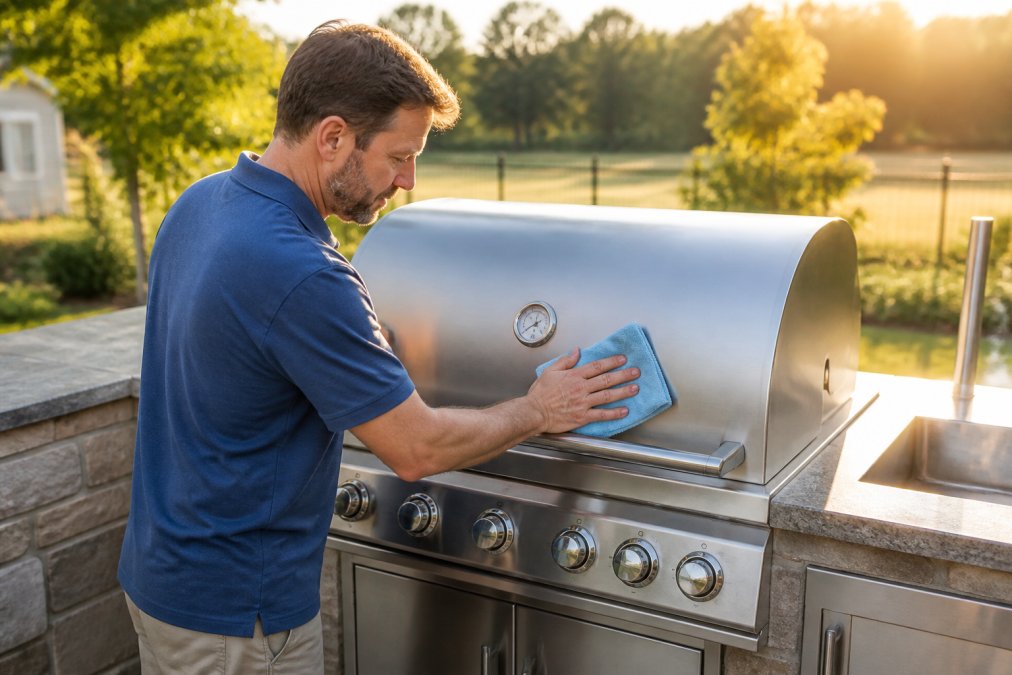
Stainless steel has a directional grain pattern, tiny linear scratches running in one direction across the surface. Always wipe in the direction of the grain. Run your hand across the appliance surface to feel which direction is smooth; that's your grain direction. This technique prevents surface dullness and maintains the reflective finish.
Best Stainless Steel Cleaner for Outdoor Grills and Kitchen Islands
For weekly deep cleaning beyond your daily routine, a dedicated stainless steel cleaner provides better results than soap and water alone.
Recommended options include:
- Mild stainless steel polish: Formulated specifically for the material, these cleaners contain light oils that restore shine without leaving residue
- White vinegar solution: A 1:1 mixture of white vinegar and water removes mineral deposits and light oxidation naturally
- Lemon oil-based cleaners: These cleaners cut through grease while conditioning the surface
Avoid abrasive scrubbing powders, harsh chemical degreasers, bleach-based cleaners, steel wool, and abrasive pads. When applying any cleaner, follow the grain direction and use a soft cloth. Allow the product to sit for 2-3 minutes on stubborn stains, then wipe thoroughly and rinse with clean water.
How to Remove Rust from Outdoor Stainless Steel
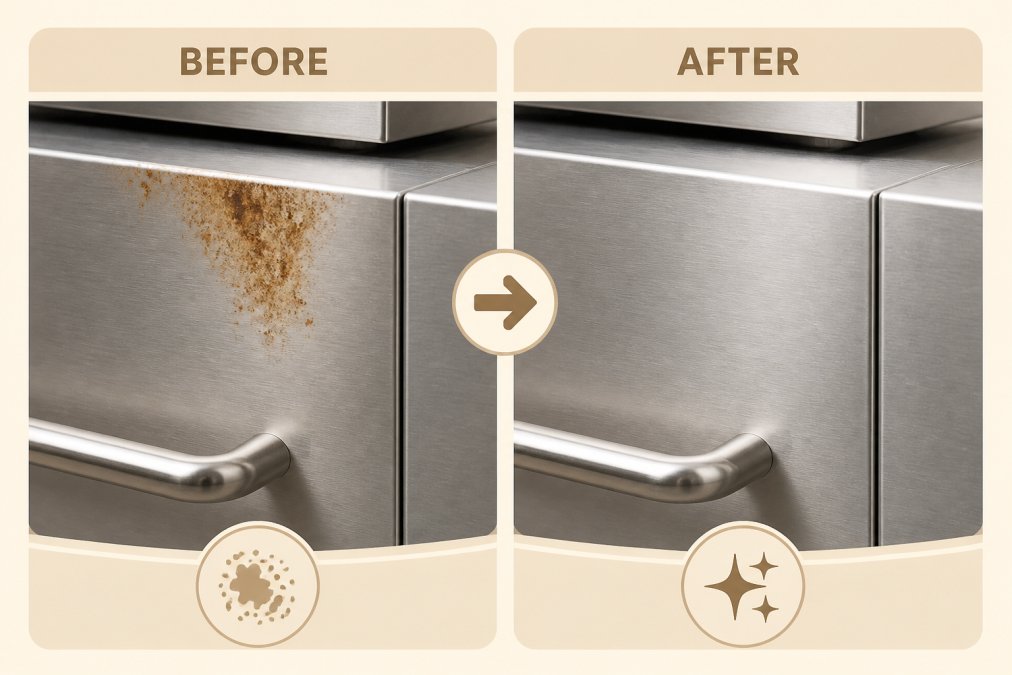
Despite its name, stainless steel can rust under certain conditions. Surface rust appears as small brown or orange spots, usually around seams, fasteners, or areas where the protective oxide layer has been compromised. The good news: surface rust is usually removable if caught early.
Surface rust removal steps:
- Identify the rusted area and assess its depth
- Apply a stainless steel rust remover or white vinegar directly to the spot
- Let it sit for 5-10 minutes to dissolve the rust
- Scrub gently with a soft-bristled brush in the grain direction
- Rinse thoroughly and dry completely
- Apply a protective stainless steel polish to restore the finish
Addressing Surface Pitting and Stubborn Stains
Surface pitting occurs when the protective oxide layer breaks down in small areas, allowing corrosion to eat into the metal. Unlike surface rust, pitting is permanent and cannot be fully removed, only managed to prevent expansion. Keep the affected area clean and dry, apply a protective sealant or stainless steel polish regularly, and monitor for expansion.
For stubborn stains that aren't rust, such as grease buildup or oxidation, a degreaser specifically formulated for stainless steel works well.
Hard Water Stain Removal Techniques
Hard water stains are mineral deposits left behind when water evaporates. They appear as white, cloudy patches or streaks on stainless steel and are purely cosmetic.
Hard water stain removal:
- Mix equal parts white vinegar and distilled water in a spray bottle
- Spray the affected area generously
- Let it sit for 5-10 minutes
- Wipe with a microfiber cloth in the grain direction
- Rinse thoroughly with distilled water
- Dry immediately with a clean cloth
The key to preventing hard water stains is drying your appliances after every cleaning or rain exposure.
Outdoor Kitchen Maintenance Schedule: Monthly and Seasonal Tasks
Maintaining stainless steel outdoor kitchen appliances requires more than daily cleaning. A structured monthly and seasonal schedule prevents small problems from becoming major ones.
Monthly Preventative Maintenance
Once per month, perform a deeper inspection and cleaning beyond your daily routine.
Monthly maintenance checklist:
- Inspect seams and crevices for trapped debris or moisture
- Check all fasteners and hinges for corrosion or looseness
- Deep clean the entire appliance surface with stainless steel cleaner
- Inspect grill grates for rust or buildup
- Check weather seals and gaskets for cracks or deterioration
- Test all moving parts (doors, drawers, burner controls)
| Task | Frequency | Time Required | Priority |
|---|---|---|---|
| Daily cleaning | Every day | 5 minutes | Critical |
| Weekly deep clean | Once per week | 15 minutes | High |
| Monthly inspection | Once per month | 15 minutes | High |
| Seasonal protection | 2x yearly | 30 minutes | Medium |
| Passivation treatment | Annually or as needed | 60 minutes | Medium |
Seasonal Storage and Protection
Seasonal changes present unique challenges for outdoor kitchen appliances. Prepare your stainless steel outdoor kitchen before winter and before the rainy season.
Pre-winter preparation:
- Deep clean all surfaces and allow to dry completely
- Apply a protective stainless steel sealant or wax
- Cover the appliances with fitted protective covers (breathable material only, never plastic)
- Ensure all covers are secure and won't blow off in wind
- Check that water drainage areas are clear of debris
Pre-rainy season preparation:
- Inspect all seams and joints for gaps where water could enter
- Apply a water-repellent protective coating
- Ensure proper drainage around the appliances
- Clear any debris from crevices where water could pool
Protective covers designed for outdoor kitchen appliances are available, but ensure they're made from breathable material. Non-breathable covers trap moisture, which accelerates corrosion.
Preventing Rust and Corrosion in Salt Air and Coastal Environments
Coastal homeowners face unique challenges when maintaining stainless steel outdoor kitchen appliances. Salt air contains chloride ions that penetrate the protective oxide layer of stainless steel, triggering corrosion and pitting within months if proper protocols aren't followed.
Coastal-specific maintenance strategies:
- Rinse the entire appliance with fresh water weekly
- Increase cleaning frequency to twice weekly instead of daily
- Use distilled water for rinsing to avoid adding minerals to salt residue
- Apply protective sealants monthly rather than seasonally
- Consider 316-grade stainless steel exclusively for coastal installations
- Install appliances in locations with maximum air circulation and minimal direct salt spray exposure
The Passivation Process for Long-Term Protection
Passivation is a specialized chemical treatment that strengthens the protective oxide layer on stainless steel. For outdoor kitchen appliances in harsh environments, passivation significantly extends longevity by removing free iron particles and creating a thicker, more uniform oxide layer.
When to passivate:
- After installation (many manufacturers do this, but verify)
- When surface rust appears despite proper maintenance
- Annually in coastal environments
- Every 2-3 years in typical outdoor climates
Professional vs. DIY passivation:
Professional passivation involves chemical processes best left to specialists. However, consumer-grade passivation products exist for homeowners. To apply a DIY passivation treatment:
- Clean the entire surface thoroughly and allow to dry
- Apply the passivation product according to package instructions
- Allow the required contact time (typically 15-30 minutes)
- Rinse thoroughly with distilled water
- Dry completely
- Allow 24 hours before using the appliances
Professional passivation services cost $200-$500 for a standard outdoor kitchen island, but the extended protection often justifies the expense in coastal areas.
What to Avoid: Damaging Chemicals and Tools
Many common household cleaners and tools damage stainless steel. Understanding what to avoid is as important as knowing what to use.
Chemicals to never use on stainless steel:
- Bleach and bleach-based cleaners
- Chlorine-based pool chemicals
- Harsh acidic cleaners
- Abrasive scouring powders
- Oven cleaners and degreasers containing caustic soda
- Window cleaners with ammonia
- Acetone or other solvents
Tools and techniques to avoid:
- Steel wool (leaves iron particles that rust)
- Abrasive scouring pads
- Wire brushes
- Sandpaper or grinding tools
- High-pressure washers (damages seals and forces water into crevices)
- Scrubbing against the grain direction
High-pressure washers deserve special mention. While they seem efficient, they force water into seams and joints, creating pockets of trapped moisture that trigger corrosion from the inside out. A gentle rinse with a hose and soft cloth is far safer.
Polishing and Restoring Surface Shine
Over time, even well-maintained stainless steel loses its original shine. Regular polishing restores the reflective finish and provides an additional protective layer.
Polishing frequency:
- High-traffic outdoor kitchens: monthly
- Standard use: quarterly
- Minimal use: twice yearly
Polishing process:
- Clean the surface thoroughly with mild soap and water
- Allow to dry completely
- Apply stainless steel polish in the direction of the grain
- Let the polish sit for 2-3 minutes
- Buff with a clean microfiber cloth, using circular motions
- Wipe away excess polish with a dry cloth
- Buff a final time for maximum shine
Quality stainless steel polishes contain light oils that restore shine while providing a thin protective coating. For appliances with significant surface dullness, stainless steel restoration products are available. These contain mild abrasives that remove the dull outer layer, revealing the shiny surface beneath.
Maintaining Your Investment: Premium Outdoor Kitchen Islands
Your outdoor kitchen island represents a significant investment. Proper maintenance of stainless steel outdoor kitchen appliances protects that investment and ensures years of beautiful, reliable performance.
The Rooms Outdoors 46 In. 4-Burner 72000 BTU Propane Gas Grill Island Outdoor Kitchen with Refrigerator, Sink in Black Stainless Steel exemplifies premium construction with 304 stainless steel components designed to withstand outdoor conditions. Black stainless steel, a popular alternative to traditional polished stainless, requires similar care but shows fingerprints less noticeably.
A comprehensive maintenance approach includes:
- Daily care: 5-minute cleaning routine with mild soap and microfiber cloth
- Weekly maintenance: Deeper cleaning with stainless steel cleaner
- Monthly inspection: Check for damage, corrosion, or mechanical issues
- Seasonal preparation: Protective treatments before harsh weather
- Annual assessment: Consider professional passivation or restoration if needed
Homeowners who commit to this schedule report that their outdoor kitchen islands look nearly new after 5-10 years of regular use. Those who neglect maintenance often see significant deterioration within 2-3 years.
Maintaining stainless steel outdoor kitchen appliances is the difference between a backyard that looks premium and welcoming versus one that appears weathered and neglected. Your outdoor kitchen is where memories happen, where family gathers, where entertaining becomes effortless. Rooms Outdoors helps you protect that investment with premium appliances built for longevity and finished with materials that reward proper care. Our 304 stainless steel construction, integrated refrigeration, and professional-grade grills are designed to look stunning for decades when maintained thoughtfully. Shop the collection today and start building your outdoor retreat with confidence.
Frequently Asked Questions
What is the best cleaner for outdoor stainless steel appliances?
Mild dish soap mixed with warm water is safe for daily cleaning of stainless steel outdoor kitchen appliances. For tougher buildup, use a dedicated stainless steel polish or a mixture of white vinegar and water. Avoid abrasive pads and steel wool, which scratch the surface. Always rinse thoroughly with clean water and dry with a microfiber towel to prevent mineral deposits and water spots. For stubborn stains, commercial degreasers designed for stainless steel work well when applied sparingly and wiped along the grain direction.
How often should I clean my outdoor kitchen appliances?
Follow an outdoor kitchen maintenance schedule that includes daily rinsing after use, weekly deep cleaning with mild soap and water, and monthly polishing with stainless steel polish. In coastal environments with salt air exposure or humid climates, increase weekly cleaning to twice weekly to prevent corrosion resistance breakdown. Seasonal inspections every three months help catch surface oxidation and environmental contaminants early. After heavy use or exposure to chlorine, rain, or air pollutants, clean immediately to protect the surface finish.
Does WD-40 damage stainless steel appliances?
While WD-40 can temporarily protect stainless steel, it leaves an oily residue that traps moisture and contaminants, potentially causing surface pitting over time. For outdoor kitchen appliances, use products specifically formulated for stainless steel instead. If you do use WD-40, wipe it away completely with a clean cloth and follow with a proper stainless steel polish. Better alternatives include food-grade mineral oil or dedicated stainless steel protective sealants designed for outdoor use that won't attract dust or degrade the surface finish.
Can I use Dawn dish soap to clean my outdoor grill?
Yes, mild dish soap like Dawn is safe for cleaning stainless steel outdoor grills. Mix a small amount with warm water and apply with a non-abrasive cloth, working along the grain direction. Rinse thoroughly to remove all soap residue, which can leave spots if left to dry. For daily cleaning after cooking, this gentle method prevents damage to the protective oxide layer that provides corrosion resistance. For monthly deep cleaning or stubborn food residue and grease buildup, use a dedicated stainless steel degreaser formulated for outdoor appliances, then follow with mild soap and water.
This article was written using GrandRanker