

Premium Outdoor Kitchen Island Kits: 2026 Buyer's Guide
Table of Contents
- Premium Outdoor Kitchen Island Kits: Quick Comparison Table
- What Makes a Premium Outdoor Kitchen Island Kit Worth the Investment
- Modular Grill Island Kits vs. Pre-Assembled Complete Packages
- Foundation and Site Preparation: The Hidden Cost Most Buyers Ignore
- Material Selection: Stainless Steel, Stone Veneer, and Climate-Specific Choices
- DIY Installation vs. Professional Setup: What You Need to Know
- Permitting, HOA Compliance, and Gas Line Installation Requirements
- Total Cost of Ownership Calculator: Beyond the Sticker Price
Premium Outdoor Kitchen Island Kits: 2026 Buyer's Guide
Last Updated: July 22, 2026
Premium Outdoor Kitchen Island Kits: Quick Comparison Table
When homeowners invest in premium outdoor kitchen island kits, they're making a commitment to years of outdoor entertaining. The market offers everything from fully assembled islands to modular systems you can customize to fit your exact space and style.
| Kit Type | Price Range | Assembly | Best For | Key Differentiator |
|---|---|---|---|---|
| Pre-Assembled Complete Packages | $4,500-$12,000 | Minimal (connections only) | Homeowners wanting turnkey solutions | Ships fully assembled, ready to use |
| Modular Grill Island Kits | $3,800-$7,500 | Moderate (component assembly) | Those prioritizing customization | Mix-and-match components for flexibility |
| Custom Stainless Steel Islands | $9,000-$19,000+ | Professional installation | High-end aesthetic seekers | 304-grade stainless, lifetime warranties |
| Ready-to-Finish Concrete Composite | $9,400-$19,000 | DIY-friendly base, pro finishing | Budget-conscious customizers | Durable foundation for stone/tile finishes |
What Makes a Premium Outdoor Kitchen Island Kit Worth the Investment
The difference between a basic grill setup and a premium outdoor kitchen island kit comes down to engineering, materials, and longevity. A quality island integrates refrigeration, storage, countertop workspace, and weather resistance into a cohesive system built to withstand years of sun, rain, and temperature swings.
According to research from National Association of Home Builders, outdoor kitchen projects fail typically due to inadequate foundation preparation or material mismatches to local climate. Premium kits address this with engineered bases, sealed cabinetry, and marine-grade components.
A premium outdoor kitchen island kit typically includes a high-performance grill (4-6 burners, 60,000+ BTU), integrated refrigeration, stainless steel access doors, and substantial countertop surface. The Modular Outdoor Kitchen BBQ Island at Rooms Outdoors combines a 104-inch footprint with a propane gas grill, compact refrigerator, storage cabinets, and rotisserie kit, priced at $4,452.68. This represents the entry point to truly functional outdoor cooking without compromise.
Modular Grill Island Kits vs. Pre-Assembled Complete Packages
Choosing between modular and pre-assembled systems depends on your priorities: flexibility or convenience.
Modular systems break the island into components, base frame, countertop, appliances, storage modules, that you assemble on-site. Napoleon OASIS Modular Outdoor Kitchen Kits exemplify this approach, starting at $3,849 and allowing you to mix 500 or 700 Series grills with various storage and countertop options. You customize the layout to your exact space and upgrade incrementally. The tradeoff is assembly complexity and lead times of 6-10 weeks for custom configurations.
Pre-assembled packages arrive nearly complete. Bull Outdoor Kitchen Islands and Cal Flame BBQ Islands, starting at $3,800, ship fully assembled. Setup takes hours, not weeks. The limitation is inflexibility, you get the manufacturer's configuration, and customization options mean waiting for a custom build.
For most homeowners, pre-assembled wins on convenience. But if your backyard has unusual dimensions, modular flexibility justifies the assembly effort.
Foundation and Site Preparation: The Hidden Cost Most Buyers Ignore
This is where most outdoor kitchen projects fail. A premium outdoor kitchen island kit sitting on an inadequate foundation will shift, crack, and fail within two to three years.
Your foundation must account for frost depth, drainage, soil stability, and local building codes. In cold climates, frost heave can lift a 500-pound island several inches. In wet climates, poor drainage leads to standing water beneath the base, promoting rust and rot. Most manufacturers recommend a 4-6 inch concrete pad, reinforced with gravel base and proper slope for drainage. This costs $800-$2,000 depending on your patio size and soil conditions.
Professional installation typically includes site assessment, foundation preparation, and utility connections, costing $1,500-$3,000 in labor. Before ordering any premium outdoor kitchen island kit, budget for site prep and get a local contractor to assess soil conditions, frost depth, and drainage.
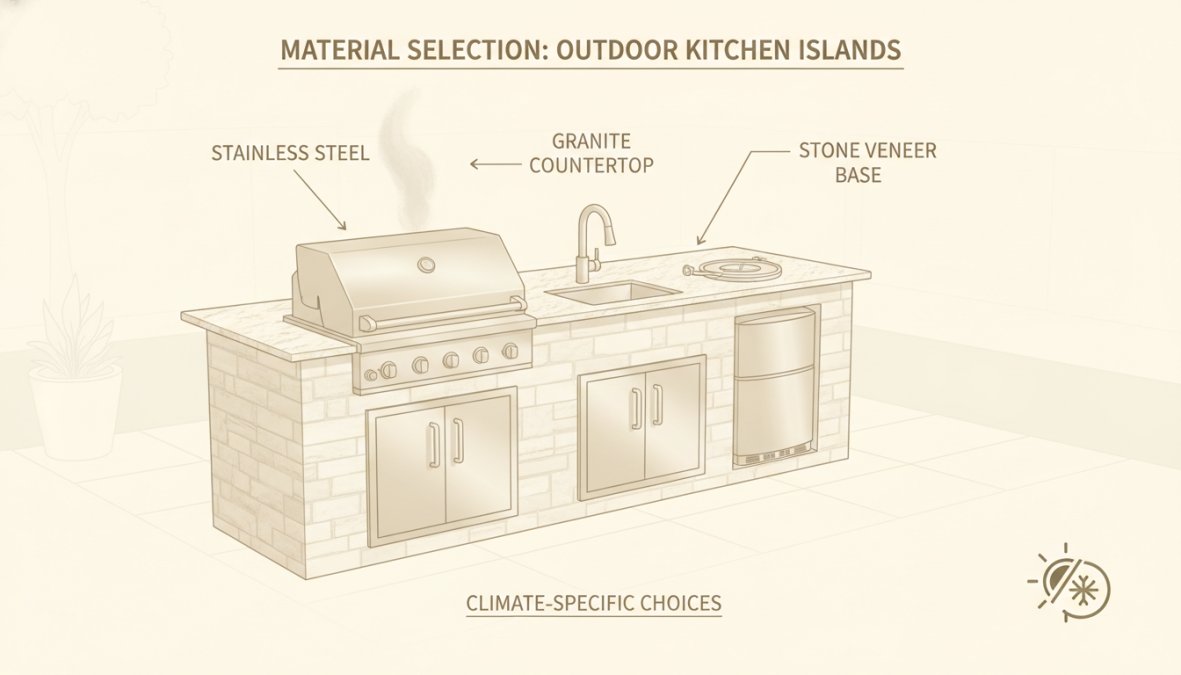
Material Selection: Stainless Steel, Stone Veneer, and Climate-Specific Choices
The materials you choose determine how your island weathers the elements and how it looks five years from now.
Premium Stainless Steel Components
304-grade stainless steel is the industry standard for outdoor kitchens. It contains 18% chromium and 8% nickel, creating a passive oxide layer that prevents rust. Danver Stainless Outdoor Kitchens uses exclusively 304-grade cabinetry, with 316-grade (higher nickel content) available for coastal properties where salt spray accelerates corrosion. Pricing for Danver runs $13,000-$19,000 for cabinets alone.
430-grade stainless steel is cheaper but offers less corrosion resistance. Over time, you'll notice surface discoloration and rust spots, especially in humid climates or near salt water. Most premium outdoor kitchen island kits use brushed or satin finishes, which hide fingerprints and water spots better than polished.
Stone and Masonry Island Finishes
Stone veneer over a concrete or composite base creates the visual anchor of your outdoor kitchen. Natural stone offers timeless aesthetics but requires sealing every 2-3 years. Manufactured stone veneer is lower maintenance and costs less.
Granite countertops are durable and heat-resistant, making them ideal for outdoor cooking. A 6-foot granite countertop runs $1,500-$3,000 installed. Porcelain tile is a budget alternative at $800-$1,500 but can crack under thermal stress if not properly installed.
Stacked stone veneer creates a rustic, upscale look but costs $3,000-$6,000 for a 4-foot island. Brick or faux brick is cheaper ($1,500-$2,500) but dates faster. Smooth stucco is affordable ($1,000-$2,000) but requires repainting every 5-7 years.
Climate-Specific Material Recommendations
Humid and tropical climates (Florida, coastal regions, Pacific Northwest): Use 316-grade stainless steel or marine-grade aluminum. Choose sealed granite or porcelain tile for countertops.
Cold climates (Northeast, Midwest, Mountain West): Ensure proper drainage and frost-protected foundation. Use sealed stone veneer that won't absorb moisture and crack during freeze-thaw cycles. Composite bases outperform wood in these environments.
Arid climates (Southwest, high desert): UV exposure is the enemy. Use light-colored stone veneer to reflect heat. Sealed granite and porcelain tile perform well.
Temperate climates (California, parts of the South): You have the most flexibility. Focus on design preference rather than climate constraints.
DIY Installation vs. Professional Setup: What You Need to Know
The choice between DIY and professional installation hinges on complexity, time, and risk tolerance.
DIY installation works if your island arrives pre-assembled or modular and you're comfortable with basic carpentry and utility connections. Positioning, leveling, and electrical connections are manageable. Gas line connections should always be handled by a licensed professional, improper connections create fire and safety hazards. Expect 8-16 hours of labor for a modular or pre-assembled island.
Professional installation costs $1,500-$3,000 but ensures proper leveling, gas line safety, and utility integration. For islands over $8,000, professional installation is worth the investment.
Permitting, HOA Compliance, and Gas Line Installation Requirements
Before you order, check local regulations. Most jurisdictions require permits for permanent outdoor structures and gas line installations.
Permitting varies widely. Expect permit costs of $200-$1,000 and approval timelines of 2-6 weeks. Contact your local building department early to understand requirements.
HOA compliance is critical in deed-restricted communities. Many HOAs require architectural approval before installing outdoor kitchens. Get written approval before ordering.
Gas line installation must be handled by a licensed professional in most jurisdictions. A new line from your meter to the island costs $800-$2,000 depending on distance and complexity. National Fuel Gas Code requirements specify that gas line installations must be performed by licensed professionals and inspected before activation.
Water lines for sinks require similar professional installation, costing $600-$1,500 with proper drainage and freeze protection in cold climates.
Total Cost of Ownership Calculator: Beyond the Sticker Price
The island price is just the beginning. A true premium outdoor kitchen island kit costs more over its lifetime than the sticker price suggests.
Initial purchase: $4,500-$12,000 for a quality pre-assembled kit; $9,000-$19,000+ for custom stainless steel systems.
Site preparation and foundation: $800-$2,000 for concrete pad and gravel base.
Installation labor: $1,500-$3,000 for professional setup, gas line, and utility connections.
Permits and inspections: $200-$1,000 depending on jurisdiction.
Finishing (stone, tile, stucco): $1,500-$6,000 if not included in the kit.
Annual maintenance (years 1-5):
- Sealing granite or stone: $200-$400 annually
- Grill cleaning and burner maintenance: $100-$300 annually
- Rust prevention and touch-ups: $50-$200 annually
- Unexpected repairs: $300-$800 annually
Total five-year cost: $14,000-$28,000.
Premium outdoor kitchen island kits justify their cost through durability, warranty coverage, and reduced maintenance. The Custom 304 Stainless Steel Outdoor Kitchen Island at Rooms Outdoors ($4,589) includes quality materials that minimize future repairs compared to cheaper alternatives.
Transforming your backyard into an outdoor entertaining space requires choosing an island that balances quality, functionality, and your specific site conditions. Premium outdoor kitchen island kits from Rooms Outdoors combine engineered durability, professional-grade components, and curated design to create spaces built for connection and comfort. With free shipping on most orders over $1,500 within the continental U.S. and secured payment processing, you can shop the collection today and begin your outdoor kitchen transformation with confidence.
Frequently Asked Questions
What's the difference between modular outdoor kitchen island kits and pre-assembled complete packages?
Modular kits ship as components that require assembly and customization, you choose individual pieces like grills, refrigerators, and countertops to fit your space. Pre-assembled packages arrive mostly built, requiring only gas and electrical connections. Modular options offer flexibility and often lower starting prices ($3,849-$4,500), while complete packages provide convenience but less customization, typically ranging from $4,450-$9,686. Choose modular if you have specific design preferences; choose pre-assembled for faster installation.
How much should I budget for foundation and site preparation before installing a premium outdoor kitchen island kit?
Foundation costs typically range from $500-$3,000 depending on soil stability, drainage, and whether you need concrete pads or gravel base. Poor site prep leads to settling, cracking, and appliance misalignment. Assess your backyard's slope, soil composition, and proximity to utilities before purchasing. Many homeowners underestimate this cost, it's essential to prevent expensive repairs within the first year. Professional site evaluation costs $200-$500 but often saves thousands in corrective work.
Do premium outdoor kitchen island kits require permitting and gas line installation?
Most jurisdictions require permits for outdoor kitchens, especially those with gas lines. Gas line installation must be performed by a licensed professional ($800-$2,500 depending on distance from your meter). Electrical connections for refrigerators and lighting also need inspection. HOA communities may have additional restrictions on size, materials, or setback distances. Check local codes and HOA bylaws before purchasing, non-compliant installations can result in fines or removal requirements. Permitting costs typically range from $100-$500.
What materials hold up best in wet climates like the Pacific Northwest?
304-grade stainless steel (or higher 316-grade) resists corrosion better than lower grades. Avoid powder-coated finishes in high-moisture areas, they require annual maintenance. Stone veneer and granite countertops are durable but need sealing annually. Concrete composite bases resist rot and mold better than wood. Choose materials rated for your climate: coastal areas benefit from marine-grade stainless steel, while wet inland regions need excellent drainage and sealed stone. Budget an extra 10-15% for climate-appropriate upgrades and annual maintenance.
What's included in the total cost of ownership for a premium outdoor kitchen island kit beyond the purchase price?
Total cost includes: the kit itself ($4,450-$9,686), site preparation ($500-$3,000), gas/electrical work ($800-$2,500), permitting ($100-$500), annual maintenance like sealing stone and stainless steel cleaning ($200-$400/year), and potential repairs over 10 years. A $5,000 kit often totals $9,000-$12,000 installed and maintained over five years. Factor in weather damage, appliance replacement, and refinishing costs. Rooms Outdoors' free shipping on orders over $1,500 helps offset initial costs, compare total ownership, not just sticker price.
This article was written using GrandRanker