

Stainless Steel Outdoor Cabinet Durability: What Actually Lasts
Table of Contents
- Why Stainless Steel Outdoor Cabinets Matter for Your Backyard
- 304 vs 316 Stainless Steel: Which Grade Protects Your Outdoor Kitchen
- Corrosion Resistance and Rust Prevention in Outdoor Environments
- Heat Resistance and Temperature Fluctuations: What Your Cabinets Face
- How to Clean Stainless Steel Outdoor Cabinets and Prevent Pock Marking
- Environmental Stressors: Salt Air, Humidity, and Coastal Outdoor Kitchen Design
- Powder Coating, Seam Welding, and Material Longevity
- Repairability and Sustainability of Stainless Steel Cabinets
Last Updated: August 8, 2026
Why Stainless Steel Outdoor Cabinets Matter for Your Backyard
Stainless steel outdoor cabinet durability depends on material selection, environmental exposure, and maintenance practices. A 304 stainless steel island might perform flawlessly in Denver's dry climate but show visible pitting within two years on the Florida coast. Understanding what actually lasts means knowing the materials, grades, environmental stressors, and maintenance requirements that separate a retreat you'll enjoy for life from one that becomes a source of frustration.
Your outdoor kitchen represents a significant investment. The Custom 304 Stainless Steel Outdoor Kitchen Island with Sink & Gas BBQ Grill starts at $4,589, and premium models exceed $6,000. This guide breaks down the real durability factors that matter: the differences between stainless steel grades, how environmental stressors affect performance, and what to expect based on your location and use patterns.

304 vs 316 Stainless Steel: Which Grade Protects Your Outdoor Kitchen
The grade of stainless steel you choose is the single most consequential decision for long-term durability. Not all stainless steel performs equally in outdoor environments.
What Makes 316 Marine-Grade Superior
316 stainless steel is engineered specifically for harsh outdoor environments through the addition of molybdenum, an alloying element that dramatically improves corrosion resistance compared to 304. This extra element creates a denser passive layer on the surface, protecting against salt air, moisture, and temperature fluctuations. This is why naval vessels, offshore platforms, and high-end coastal properties specify 316 over 304.
The trade-off is cost. 316 stainless steel typically commands a 20-30% premium over 304. For homeowners in moderate climates or inland locations, this premium may not be justified. For coastal properties, it's often the difference between a cabinet that maintains its appearance and one that requires extensive refinishing or replacement.
When 304 Stainless Steel Works Well Enough
304 stainless steel is the most commonly used grade for outdoor applications and performs admirably in most non-coastal environments. It contains chromium and nickel in proportions that create a protective oxide layer, resisting corrosion in moderate conditions.
In inland locations without salt air exposure, 304 delivers excellent durability and maintains its finish with proper maintenance. Denver, Phoenix, Austin, and most continental U.S. locations see 304 stainless steel cabinets perform reliably for 15+ years without significant corrosion issues. The 46 In. 4-Burner Propane Gas Grill Island from Rooms Outdoors uses durable 304 stainless steel construction and delivers the performance homeowners expect in non-coastal climates.

Surface oxidation can occur on 304 in humid environments, but it's typically superficial and easily reversed with proper cleaning. The distinction between surface oxidation and true corrosion matters: oxidation is cosmetic, corrosion is structural. 304 resists structural corrosion well in non-salt environments.
Corrosion Resistance and Rust Prevention in Outdoor Environments
Corrosion resistance in stainless steel comes from the passive layer, an invisible oxide coating that forms on the surface and protects the underlying metal. This layer regenerates itself when exposed to oxygen. The passivation process creates and maintains this protective layer, but in outdoor environments, it's constantly challenged by moisture, salt, and temperature changes.
Pock marking, small surface pits that appear as tiny dark spots, is visual evidence that the passive layer has failed in localized areas. Salt air, chlorine, and certain cleaning chemicals accelerate this failure. Once pitting begins, it tends to spread because the pit itself becomes a corrosion site that's harder to protect. Prevention is far more effective than repair.
The difference between 304 and 316 becomes most apparent here. The molybdenum in 316 makes the passive layer more resistant to breakdown in salt-rich environments. A 304 cabinet in Miami might show pitting after 3-5 years of exposure. A 316 cabinet in the same location might remain clean for 10-15 years with equivalent maintenance.
Galvanic corrosion occurs when dissimilar metals touch in the presence of moisture, accelerating corrosion on the more reactive metal. If your stainless steel cabinet hardware or fasteners are made from a different metal than the cabinet body, galvanic corrosion can develop at connection points. Premium outdoor kitchen cabinets use stainless steel fasteners throughout to eliminate this risk.
Heat Resistance and Temperature Fluctuations: What Your Cabinets Face
Temperature fluctuations cause metal to expand and contract, and repeated cycling creates stress on welds, fasteners, and overall structural integrity. Stainless steel maintains structural integrity at temperatures well beyond what outdoor cabinets will experience, but differential expansion between the stainless steel body and other materials creates stress at connection points.
In climates with extreme seasonal temperature swings, like the upper Midwest or mountain regions, thermal cycling is more pronounced. A cabinet experiencing 100-degree temperature swings from summer to winter undergoes more expansion and contraction cycles than one in a moderate climate. Over 10-20 years, this can loosen fasteners, create micro-gaps in welds, and allow moisture to penetrate sealed areas.
Seam welding quality becomes critical in this context. A poorly executed weld is a stress concentration point where cracks initiate under thermal stress. Premium outdoor kitchen cabinets use continuous seam welding with proper heat treatment to minimize these risks. The OASIS Outdoor Kitchen Kit from Rooms Outdoors addresses this through strong construction with attention to seam integrity and material compatibility.

How to Clean Stainless Steel Outdoor Cabinets and Prevent Pock Marking
Maintenance is where most homeowners lose the battle against corrosion. A cabinet that could last 20 years deteriorates in half that time because the owner doesn't understand proper cleaning protocols.
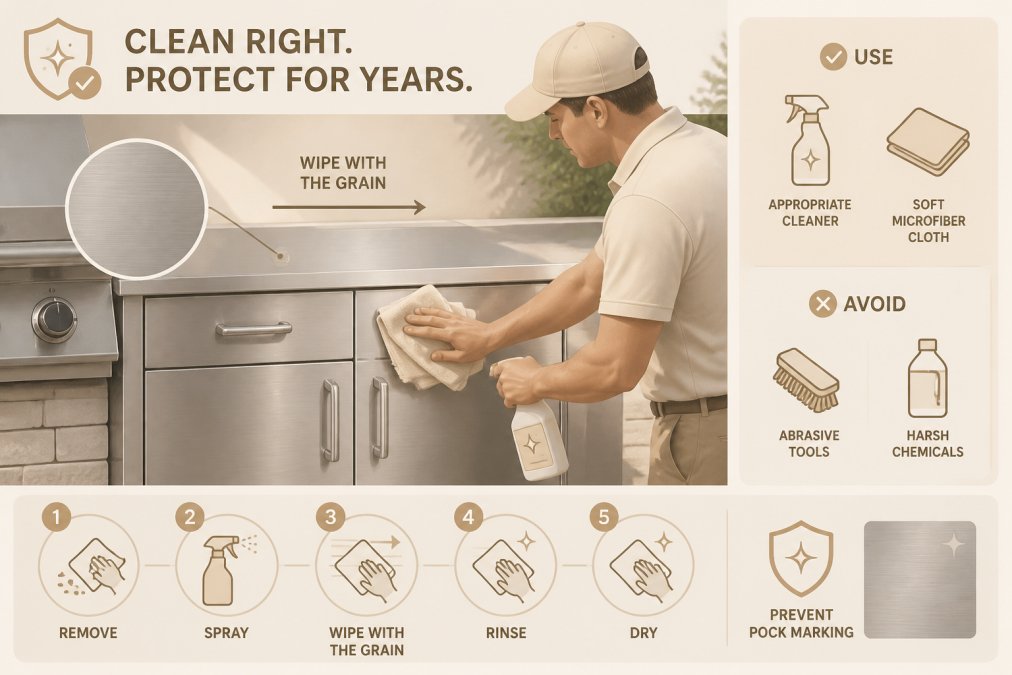
Always clean with the grain of the stainless steel. Use a soft microfiber cloth, never abrasive scouring pads or steel wool. Damage from one aggressive cleaning session can take months to repair through natural passivation.
Water quality matters more than most people realize. In areas with hard water or high chlorine content, use distilled water for the final rinse. Mineral deposits and chlorine residue can initiate pitting, especially in coastal areas. A simple final rinse with distilled water and a soft cloth eliminates this risk.
Frequency of cleaning depends on your location. In inland areas with moderate humidity, monthly cleaning is usually sufficient. In coastal regions, weekly cleaning is more appropriate. Avoid acidic or chlorine-based cleaners; use pH-neutral cleaners specifically formulated for stainless steel, or a simple solution of mild dish soap and warm water.
Pock marking prevention comes down to preventing moisture from sitting on the surface. After cleaning, dry the cabinet thoroughly with a soft cloth. If you live in a humid climate and notice water spots forming naturally, wipe them down before they can cause damage.
Environmental Stressors: Salt Air, Humidity, and Coastal Outdoor Kitchen Design
Environmental stressors are the variables you cannot control, making them the most important to understand.
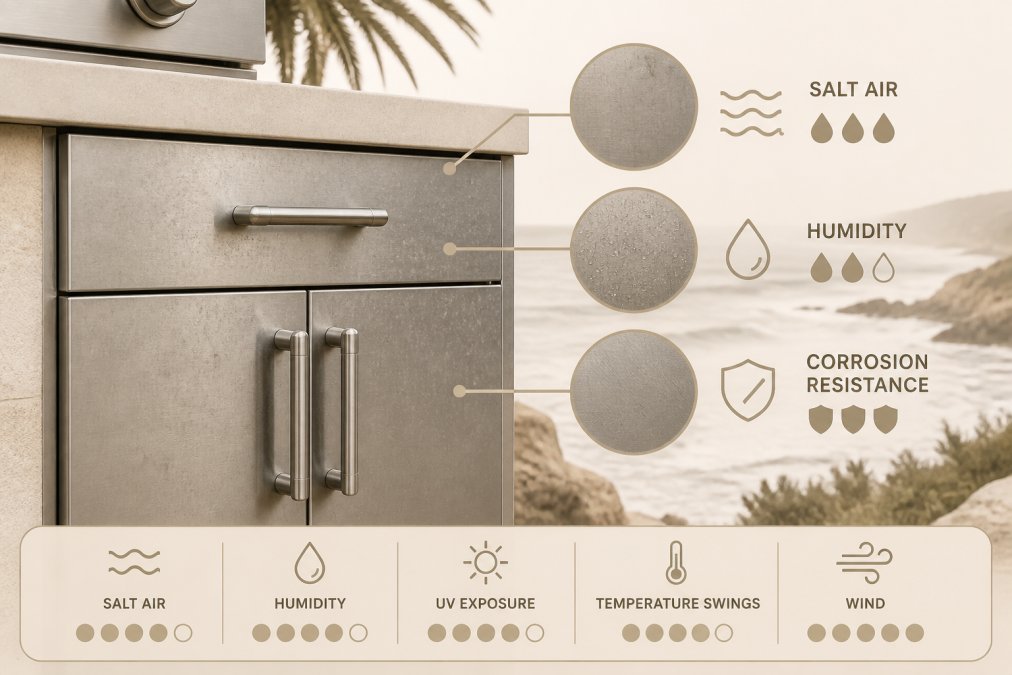
Salt air exposure is the most aggressive environmental stressor. Saltwater spray contains sodium chloride particles that settle on the cabinet surface and create an electrolytic environment accelerating corrosion. Within one mile of the ocean, salt air exposure is constant and severe. Between one and three miles, it's moderate. Beyond three miles, salt air is usually not a primary concern unless prevailing winds carry salt inland.
Humidity levels determine how long moisture remains on the cabinet surface. In the Pacific Northwest, moisture lingers longer but corrosion is slower. In Florida, high humidity combined with salt air is particularly aggressive. Coastal outdoor kitchen design requires material choices acknowledging these realities. Using 316 marine-grade stainless steel is the foundation, but powder coating adds another protective layer by creating a physical barrier between the stainless steel and the environment.
UV exposure damages not just the stainless steel finish but also any protective coatings. Coastal regions with high sun intensity see faster degradation of protective coatings. Selecting UV-stable powder coatings and scheduling periodic recoating prevents long-term issues.
Powder Coating, Seam Welding, and Material Longevity
Powder coating is a protective layer serving multiple functions in outdoor stainless steel cabinets. It provides aesthetic enhancement, protects the underlying stainless steel from direct environmental exposure, and extends overall lifespan significantly.
The durability of powder coating depends on quality of application and specific formulation. Premium powder coatings engineered for outdoor use include UV inhibitors to prevent fading and degradation. Budget powder coatings may fail within 3-5 years in harsh environments. Quality powder coatings last 10-15 years with proper maintenance.
Seam welding quality directly impacts how long a cabinet survives in outdoor conditions. A continuous, properly executed weld creates a seal preventing moisture from penetrating interior cabinet spaces. A poorly executed weld leaves gaps where moisture accumulates, leading to internal corrosion that's invisible until damage is severe.
Material longevity depends on the entire system working together. The grade of stainless steel, quality of welds, application and maintenance of protective coatings, and cabinet design to prevent moisture accumulation all contribute to final lifespan. A cabinet scoring well on all factors can easily last 20-30 years. One scoring poorly on any factor might fail within 5-10 years.
The 3-Tier Outdoor Grill Cart from Rooms Outdoors uses heavy-duty all-weather construction with stainless steel components supporting up to 300 pounds, reflecting an understanding of what actually lasts in outdoor environments.
Repairability and Sustainability of Stainless Steel Cabinets
Repairability is a durability factor that significantly impacts true cost of ownership. A cabinet that can be repaired when damaged lasts longer and costs less over its lifetime than one that must be replaced.
Stainless steel is highly repairable. Dents can be carefully worked out without damaging the material. Surface scratches and minor corrosion can be refinished through passivation and polishing. Damaged sections can be cut out and rewelded. Compare this to powder-coated aluminum or composite materials, which often cannot be effectively repaired once damaged.
Stainless steel is infinitely recyclable without degradation in quality. A cabinet reaching the end of its useful life can be melted down and reformed into new products indefinitely. The longevity of stainless steel cabinets means less frequent replacement, reducing environmental footprint over a 30-year span. A cabinet lasting 25 years has lower environmental impact than one lasting 10 years and requiring 2-3 replacements.
Recycling infrastructure for stainless steel is well-established in the United States. When your cabinet eventually reaches the end of its life, it can be recycled through standard metal recycling programs. The scrap value of stainless steel makes recycling economically viable.
Stainless steel outdoor cabinet durability depends on material grade, environmental exposure, maintenance, and construction quality working together. In non-coastal climates, 304 stainless steel with proper maintenance delivers excellent long-term performance. In coastal regions, 316 marine-grade stainless steel becomes the sensible choice despite the premium cost.
At Rooms Outdoors, we understand that an outdoor kitchen is an investment in your lifestyle. The cabinets and islands you choose should reflect both aesthetic preferences and realistic durability expectations for your specific location. Our curated selection of stainless steel outdoor kitchen solutions, including the OASIS Outdoor Kitchen Kit and custom 304 stainless steel islands, is designed for homeowners who want cabinets that maintain their beauty and functionality for decades. Explore our collection today and discover how quality materials and thoughtful design create outdoor spaces built to last.
Frequently Asked Questions
Is stainless steel good for an outdoor kitchen?
Yes, stainless steel is one of the best materials for outdoor kitchens because of its corrosion resistance and heat resistance. The right grade, 304 or 316, combined with proper maintenance protects your investment for decades. The Custom 304 Stainless Steel Outdoor Kitchen Island with Sink & Gas BBQ Grill demonstrates how 304 stainless steel delivers durability in a premium outdoor setting. However, performance depends on your climate: coastal areas with salt air exposure benefit from 316 marine-grade, while inland regions work well with 304.
What's the difference between 304 and 316 grade stainless steel for outdoor use?
304 stainless steel contains chromium and nickel, offering good corrosion resistance for most environments. 316 marine-grade adds molybdenum, which significantly improves resistance to salt air and pitting corrosion. In coastal climates with high humidity and salt exposure, 316 prevents pock marking and surface oxidation better than 304. For inland areas away from salt spray, 304 provides excellent durability at a lower cost. Both grades maintain structural integrity and tensile strength in temperature fluctuations, but 316's alloy composition makes it the premium choice for harsh environmental stressors.
How do you maintain stainless steel outdoor cabinets to prevent rust?
Clean your stainless steel outdoor cabinets monthly with a soft cloth and mild soap and water, then dry thoroughly to prevent water spots and surface oxidation. For stubborn residue, use a stainless steel cleaner applied with the grain. Avoid chlorine-based cleaners and abrasive scrubbers, which damage the passivation layer. In coastal areas, rinse more frequently to remove salt deposits. Inspect seam welding and edges regularly for signs of corrosion. Annual deep cleaning with a specialized stainless steel polish restores UV stability and finish durability. Prompt maintenance prevents pock marking and extends the lifespan of your cabinet hardware and structural components.
What environmental factors affect how long a stainless steel outdoor cabinet lasts?
Durability factors include salt air exposure, humidity levels, temperature fluctuations, UV radiation, and proximity to pools or sprinkler systems. Coastal climates with high moisture resistance demands require 316 marine-grade stainless steel. Inland regions experience less environmental stress, making 304 stainless steel sufficient. Powder coating adds an extra protective layer against UV stability and weather damage. Gauge thickness and seam welding quality impact longevity, thicker materials and well-executed welds resist structural damage better. With proper maintenance protocols and the right grade for your climate, stainless steel outdoor cabinets last 20+ years, making them a worthwhile investment for your outdoor living space.
This article was written using GrandRanker