

Stainless Steel vs Granite Outdoor Counters: A Complete 2026 Guide
Table of Contents
- Stainless Steel vs Granite Outdoor Counters: Quick Comparison
- Stainless Steel Outdoor Countertops: Durability and Weather Resistance
- Granite Outdoor Countertops: Natural Stone Appeal and Performance
- Outdoor Kitchen Countertop Materials: Maintenance and Cleaning Requirements
- Outdoor Countertop Durability: Long-Term Performance and Repairability
- Cost of Outdoor Kitchen Countertops: Budget Breakdown and ROI
- Outdoor Kitchen Maintenance: Regional Climate Matching
- Aesthetic Appeal and Design Integration
Stainless Steel vs Granite Outdoor Counters: A Complete 2026 Guide
Last Updated: July 27, 2026
When choosing between stainless steel vs granite outdoor counters for your backyard kitchen, you're making a decision that affects both aesthetics and long-term maintenance demands. At Rooms Outdoors, we've guided countless homeowners through this comparison, and the answer depends on your climate, budget, and lifestyle. Both materials excel in different scenarios, and understanding where each wins is what separates a satisfying outdoor kitchen from one you'll regret within two seasons.
Outdoor countertops face constant exposure to UV rays, temperature swings, moisture, and salt spray. This guide covers the material science, maintenance reality, cost breakdown, and climate-specific recommendations you need to make the right call.
Stainless Steel vs Granite Outdoor Counters: Quick Comparison
Stainless steel is a non-porous, engineered metal built for commercial kitchens; granite is a natural stone that demands regular sealing to resist staining and moisture penetration. Stainless steel shows fingerprints and scratches more visibly but requires only soap and water. Granite looks timeless and hides minor marks but needs annual sealing and careful attention to acidic spills.
For most outdoor kitchens under 400 square feet or in high-moisture climates, stainless steel wins on practicality. For larger spaces in dry climates where you prioritize visual impact, granite delivers unmatched elegance, if you're willing to maintain it.
Feature Comparison Table
| Feature | Stainless Steel | Granite | Winner |
|---|---|---|---|
| Corrosion Resistance | Excellent (304 grade) | Good (if sealed) | Stainless Steel |
| Heat Resistance | Handles 600°F+ | Handles 1000°F+ | Granite |
| Maintenance Frequency | Weekly cleaning | Annual sealing + quarterly maintenance | Stainless Steel |
| Scratch Visibility | High (shows easily) | Low (hides wear) | Granite |
| Stain Resistance | Excellent (non-porous) | Good (with sealing) | Stainless Steel |
| UV Fade Risk | None | Minimal (heat-resistant) | Tie |
| Installation Complexity | Moderate | High (requires support) | Stainless Steel |
| Cost Range | $4,452-$5,199 (Rooms Outdoors models) | $419-$600+ per slab | Stainless Steel (upfront) |
| Best For | Coastal, wet climates; frequent use | Dry climates; visual priority | Depends on location |
At a Glance: Pros and Cons
Stainless Steel Outdoor Counters
Pros:
- Food-safe, NSF-certified surface ideal for meal prep
- Resists corrosion, rust, and staining without sealing
- Hygienic and easy to sanitize
- Sleek, modern aesthetic
- Minimal maintenance: soap, water, and occasional polish
Cons:
- Shows fingerprints, water spots, and minor scratches visibly
- Can feel cold to the touch
- Requires polishing to maintain shine (optional)
- Limited color options
- Dents from heavy impacts don't pop back out
Granite Outdoor Counters
Pros:
- Unique natural patterns and colors
- Extremely heat-resistant; won't warp from direct flame
- Hides minor scratches better than stainless steel
- Timeless elegance
- Durable when properly sealed; can last 30+ years
Cons:
- Requires annual sealing to prevent moisture absorption and staining
- Porous surface means acidic spills can etch or stain if not wiped immediately
- Significantly heavier; installation requires structural support
- Thermal shock risk from rapid temperature changes
- More expensive upfront and in ongoing maintenance
Stainless Steel Outdoor Countertops: Durability and Weather Resistance
Stainless steel outdoor counters are engineered for commercial kitchen environments, which is why they excel in residential outdoor settings. The material doesn't corrode, doesn't absorb moisture, and doesn't require sealing, making it the lowest-maintenance countertop material available.
Grade 304 Stainless Steel and Corrosion Resistance
Restaurant-grade 304 stainless steel is the industry standard for outdoor kitchen cabinetry and countertops. This alloy contains chromium and nickel, which form a self-healing oxide layer that prevents rust from spreading even if the surface is scratched. According to NewAge Products technical specifications, 304-grade stainless steel is NSF certified for food safety and withstands corrosion from moisture, salt spray, and temperature fluctuations. The 1.2mm thickness used in most outdoor countertops resists denting while remaining workable for fabrication.
Heat Resistance and Food Safety
Stainless steel handles direct flame, hot cookware, and extreme temperature swings without warping or discoloring. It's NSF certified for food contact, meaning you can safely place raw meat directly on the surface.
Granite Outdoor Countertops: Natural Stone Appeal and Performance
Natural stone brings an elegance that no engineered material can replicate. Each granite slab has unique veining and color variation, creating a custom aesthetic. But this beauty comes with responsibility: granite is porous, which means it requires active maintenance to resist staining and moisture damage.
Heat Resistance and Thermal Shock
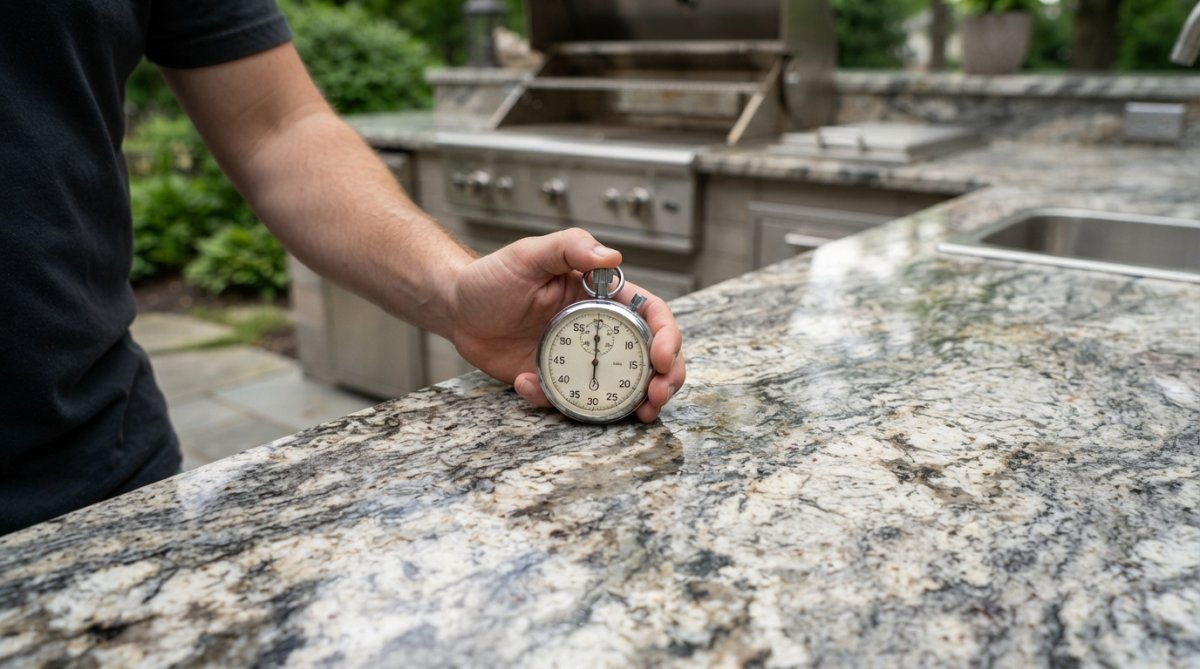
Granite is nearly indestructible when it comes to heat. You can place a 500-degree pan directly on the surface without damage. The catch is thermal shock, rapid temperature swings. Pouring ice water on hot granite can cause micro-fractures that eventually become visible cracks.
Porosity, Sealing, and Moisture Control
Granite is porous and absorbs liquids. Without sealing, spilled wine, citrus juice, or oil will stain the stone permanently. A quality stone sealer fills these voids, creating a protective barrier that lasts 12-18 months outdoors before degrading. Outdoor granite requires annual resealing because UV exposure and weather break down the sealer faster than it would indoors.
In freeze-thaw climates, if water penetrates the stone and freezes, it expands, causing spalling (surface flaking). Regions that experience winter freeze-thaw cycles need properly sealed and maintained granite, or you risk visible deterioration within 3-5 years.
Outdoor Kitchen Countertop Materials: Maintenance and Cleaning Requirements
Maintenance differences between these materials are dramatic. One requires weekly attention; the other requires annual sealing plus quarterly checks.
Stainless Steel Maintenance Schedule
Weekly: Wipe with a damp microfiber cloth and mild dish soap. Dry immediately to prevent water spots. Monthly: Polish with a stainless steel conditioner (optional). Annually: Deep clean with a specialized stainless steel cleaner to restore luster.
Stainless steel is forgiving, acidic foods, oils, and salt water won't damage the surface. The material is also non-porous, so bacteria and mold don't colonize it the way they can with stone.
Granite Sealing and Long-Term Care
Granite requires a different commitment. Before first use, the stone must be sealed with a penetrating sealer designed for outdoor exposure. Annual sealing is required every 12-18 months, and quarterly maintenance involves checking for stains or areas where water beads are no longer forming (sign the seal is failing). Wipe acidic spills immediately and avoid abrasive scrubbers, acidic cleaners, and oil-based conditioners.
Many homeowners underestimate this commitment. Granite looks beautiful for the first two years, then staining becomes noticeable if sealing lapses. Professional restoration can cost $500-$1,500 depending on damage severity.
Outdoor Countertop Durability: Long-Term Performance and Repairability
Both materials last, but how they age and what repairs cost differ significantly.
UV Degradation and Color Fade Over Time
Stainless steel doesn't fade. The brushed or polished finish remains consistent indefinitely because the material has no pigment to degrade. Granite's color is stable, but the sealer degrades. As the sealer breaks down, the stone becomes more porous again, leading to darkening in some areas where moisture accumulates. This is reversible with resealing, but it signals that maintenance is overdue.
Scratch Resistance and Repair Options
Stainless steel scratches easily, a dropped knife or aggressive scrubbing will leave visible marks. These scratches don't compromise integrity, but they affect appearance. Minor scratches can be polished out; deep ones are permanent.
Granite is harder and resists scratching better. However, granite can chip or crack if struck hard enough. Repairing granite chips requires professional stone work: the damaged area is filled with epoxy or resin tinted to match the stone, then polished smooth. This costs $300-$800 depending on damage size.
Cost of Outdoor Kitchen Countertops: Budget Breakdown and ROI
Budget constraints often drive the final decision, but cost comparison is more nuanced than material price alone.
Installation and Custom Fabrication Costs
Stainless steel countertops from Rooms Outdoors start at $4,452 for the 104" Modular Outdoor Kitchen BBQ Island with integrated stainless steel counters, sink, and compact refrigerator. The 46" 4-Burner model with granite countertops is priced at $5,199.
Granite slabs cost $419-$600+ per slab depending on type and size, but fabrication and installation add significantly. A custom granite countertop for a 46" outdoor kitchen island typically runs $1,200-$2,000 in labor and fabrication alone, plus the stone cost. Stainless steel fabrication is faster and cheaper because the material is standardized.
Over 20 years, a stainless steel countertop is significantly cheaper than granite with regular sealing and occasional repairs.
Outdoor Kitchen Maintenance: Regional Climate Matching
The best material for your outdoor counters depends partly on where you live. Climate drives maintenance demands, durability, and performance.
Coastal Climates and Salt Exposure
Salt spray accelerates corrosion in most metals and degrades sealer on stone. Stainless steel is specifically engineered to resist salt corrosion, the chromium oxide layer actively prevents rust from spreading even in salt-heavy environments. Granite in coastal areas requires more frequent sealing (every 8-12 months instead of 12-18) because salt spray breaks down the sealer faster.
If you're within 10 miles of the ocean, stainless steel is the pragmatic choice.
High-Moisture Regions and Freeze-Thaw Cycles
In the Pacific Northwest, Northeast, or other regions with frequent rain and freeze-thaw cycles, moisture management is critical. Stainless steel handles moisture without concern, water simply runs off a non-porous surface. Granite's porosity becomes a liability in freeze-thaw climates. Water that penetrates the stone and freezes expands, causing surface spalling and cracking. This damage is often irreversible.
Aesthetic Appeal and Design Integration
Both materials serve different design philosophies.
Stainless Steel: Industrial Aesthetic and Polished Finishes
Stainless steel reads as modern, professional, and intentional. It pairs naturally with contemporary outdoor kitchens, minimalist patio designs, and spaces that prioritize clean lines and functionality. The brushed finish is more forgiving of fingerprints than polished; the polished finish is more reflective and dramatic. Stainless steel integrates seamlessly with other materials and signals quality and durability to guests.
Granite: Timeless Elegance and Unique Patterns
Granite is a statement. Each slab's unique veining and color variation make it a focal point. Black Galaxy granite, for example, is deep charcoal with gold and silver speckles, instantly luxurious and eye-catching. Granite works best in traditional, transitional, or upscale contemporary outdoor kitchens. The downside is that granite's visual dominance can overwhelm smaller spaces or clash with certain design directions.
Making Your Final Decision
The choice between stainless steel vs granite outdoor counters comes down to three factors: climate, maintenance tolerance, and aesthetic priority.
Choose stainless steel if:
- You live in a coastal, high-moisture, or freeze-thaw climate
- You want minimal ongoing maintenance and sealing
- You prioritize durability and food-safety certification
- You prefer a modern, clean aesthetic
- You're building on a budget or want lower long-term costs
Choose granite if:
- You live in a dry or temperate climate with minimal freeze-thaw
- You're willing to seal annually and maintain actively
- You prioritize visual impact and natural stone elegance
- You plan to stay in the home long-term and can commit to care
- You want a material that hides minor wear better than stainless steel
Rooms Outdoors carries both options in pre-built outdoor kitchen islands, with stainless steel models starting at $4,452 and hybrid models combining stainless steel cabinetry with granite countertops at $5,199. We also offer custom fabrication for specific design requirements. Our secured payment processing and free shipping on most orders over $1,500 within the continental U.S. make upgrading your outdoor space accessible.
The material you choose today will shape your outdoor kitchen experience for the next decade. Neither choice is wrong, but one will align better with your climate, lifestyle, and maintenance expectations than the other.
Frequently Asked Questions
Which is more durable for outdoor counters, stainless steel or granite?
Both materials are highly durable, but in different ways. Grade 304 stainless steel offers superior corrosion resistance and is virtually indestructible by weather, making it ideal for high-moisture or coastal climates. Granite is extremely hard and resistant to chipping and cracking, but requires periodic sealing to prevent moisture absorption and staining. For pure durability against the elements, stainless steel edges ahead; for impact resistance, granite wins. Your choice depends on your climate and maintenance willingness.
What are the main maintenance differences between stainless steel and granite outdoor counters?
Stainless steel requires regular cleaning to prevent fingerprints and water spots, but needs no sealing. Granite requires annual sealing to maintain its non-porous protective layer and prevent stain absorption. Both resist heat well, but granite becomes very hot to the touch in direct sun. Stainless steel is easier for food-grade sanitation due to its non-porous surface. Granite's maintenance schedule is more involved, making stainless steel the lower-maintenance choice for busy homeowners.
Is stainless steel or granite more expensive for outdoor kitchen countertops?
Granite typically starts lower in material cost but requires ongoing sealing maintenance. Stainless steel countertops like those offered by Rooms Outdoors range from $4,452 to $5,199 depending on size and features, offering integrated kitchen solutions. Granite slabs from NewAge start at $419.99 per item, though installation and custom fabrication add significantly to total cost. When calculating long-term expenses, factor in granite's annual sealing costs versus stainless steel's minimal upkeep. Premium granite or custom fabrication can exceed stainless steel pricing.
Which outdoor countertop material is better for coastal climates with salt exposure?
Stainless steel, particularly Grade 304, is specifically engineered for salt-air environments and resists corrosion from coastal moisture and salt spray. Granite, while durable, is porous and can absorb salt-laden moisture if not properly sealed, leading to degradation over time. If you live near the ocean or in a high-salt-spray region, stainless steel is the superior choice. Its rust prevention properties and non-porous nature make it ideal for Pacific Northwest, coastal Florida, or any area with regular salt exposure and high humidity.
Can stainless steel outdoor countertops get too hot to use safely?
Stainless steel does retain heat in direct sunlight but is less prone to becoming dangerously hot than granite. Both materials conduct heat, but stainless steel's thermal properties are more manageable. Granite becomes significantly hotter to the touch in intense sun, which can be uncomfortable when working at the counter. To mitigate heat retention on either material, use outdoor kitchen umbrellas or shade structures. Stainless steel's brushed finish can reduce visible heat reflection compared to polished granite, making it slightly more comfortable for outdoor food preparation in sunny climates.
Transform your backyard into a retreat built for comfort and connection. Whether you choose the durability and modern appeal of stainless steel or the timeless elegance of natural stone, Rooms Outdoors has the outdoor kitchen island that matches your vision. Shop the collection today and get started with free shipping on orders over $1,500.
This article was written using GrandRanker